
Hard Money Loan: Funding, Draws, Costs and the Payoff
A total loan commitment is not all cash at closing. Follow the acquisition advance, construction draw schedules, carrying costs, and exit mechanics from term sheet to payoff.
 By EstateHawk
On this page

The act of borrowing hard money for a real estate flip: your first tip is to avoid signing an unrecorded personal guarantee on a twelve-month bridge loan carrying a twenty-four percent default interest rate and full Dutch interest accrual when your general contractor has not even pulled the municipal framing permit.
Who would have thought.
So elegant in its simplicity. Truly astonishing financial wisdom.
While we are here, let us make sure skydivers avoid exiting aircraft without parachutes, instruct mariners never to sail directly into category five typhoons, and remind enthusiastic residential flippers that gutting a load-bearing brick foundation with a rented sledgehammer might lead to ceiling sag.
No, "just borrow responsibly" is only good advice for fake real estate gurus and weekend seminar promoters who think private lending is free, unlimited cash that magically replaces equity, underwriting, and county land records.
Here is what the dictionary and fake real estate influencers will never understand: for an actual capital analyst, underwriting private credit is not a casual administrative review, it is an absolute obsession they have zero control over.
You sit down at your desk at eight in the evening, fully intending to check the draw inspection terms on a standard six-month fix-and-flip loan in Indianapolis. Four minutes later, you find yourself four hours deep into a municipal public works liquidation auction, carefully examining the maintenance logbooks of a 1974 Oshkosh WT-2206 heavy-duty dual-engine snowblower. It has an eight-hundred-and-fifty-horsepower Caterpillar V12 diesel engine dedicated entirely to driving the front rotary impeller, alongside an independent six-cylinder Cummins diesel engine tasked strictly with propelling the all-wheel-drive chassis. It weighs thirty-four thousand pounds. It can swallow fifty tons of packed snow per minute and discharge it three hundred feet into the treeline. You are mentally calculating whether you could deploy this surplus municipal behemoth to blast through four-foot snowdrifts blocking an off-market mountain cabin flip in Colorado. You are actively scrolling through archived municipal fleet maintenance forums from 2008, reading heated flame wars about whether the mechanical shear pins on the secondary ribbon auger fail prematurely when exposed to buried chunks of industrial asphalt or whether the planetary axle seals leak because the city mechanics used synthetic fluid instead of standard ninety-weight gear oil.
The Instant Gratification Monkey was having the absolute time of his life dreaming of pulverizing glacial ice walls behind the wheel of an orange industrial snow turbine. Then the Rational Decision-Maker woke up, snapped the laptop closed, and stared cold-eyed at the actual commercial term sheet on the desk.
Because what was sitting on that desk was not an imaginary fleet of municipal vehicles. It was an aggressive private loan commitment where the borrower thought they were receiving three hundred thousand dollars of working capital, but were actually walking into a brutal financial vice: a loan where fifty thousand dollars was withheld in an unreleased renovation holdback, interest was being charged on undisbursed funds from day one, origination points were deducted upfront from the purchase cash, and a looming twelve-month maturity cliff was ticking down while local building inspectors were taking eight weeks just to review architectural site plans.
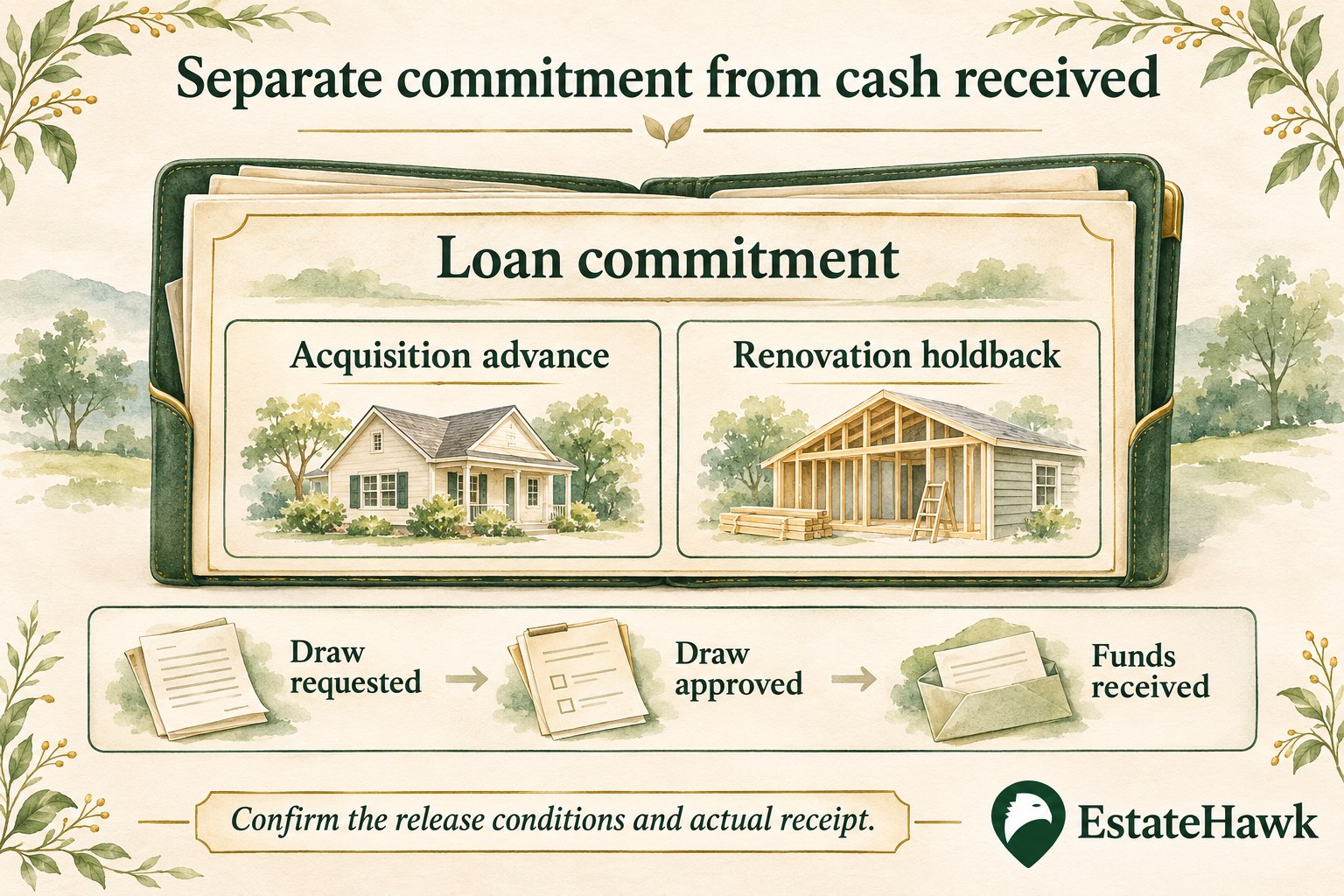
A total loan commitment is not cash in your pocket at closing. If you confuse an approved commitment amount with available liquidity, your private lender will happily foreclose on your half-finished drywall and auction your project on the county courthouse steps.
Let us dissect how hard money and bridge lending actually function under the law, how federal commercial lending exemptions shape borrower liability, why the distinction between Dutch interest and as-drawn interest can make or break your margin, how construction draw mechanics work in the field, and how to execute an airtight payoff before default interest obliterates your profit.
The Legal Framework: Commercial Exemption Versus Consumer Protection
The entire architecture of the hard money lending industry exists because of a single, deliberate boundary line drawn in federal consumer protection law.
When an everyday consumer applies for a residential mortgage to purchase a primary home, the transaction is smothered in layers of protective federal regulation. The Dodd-Frank Wall Street Reform and Consumer Protection Act, codified throughout Title 12 of the United States Code, created the Consumer Financial Protection Bureau (CFPB) and mandated exhaustive consumer mortgage disclosures under the Truth in Lending Act (TILA) and the Real Estate Settlement Procedures Act (RESPA), formally unified as TRID.
Under TRID and CFPB Regulation Z (12 C.F.R. Part 1026), institutional lenders must verify a consumer borrower's Ability-to-Repay (ATR), comply with strict Qualified Mortgage (QM) debt-to-income limits, provide a standardized Loan Estimate three business days after application, and deliver a Closing Disclosure three business days before closing. Furthermore, the Home Ownership and Equity Protection Act (HOEPA), codified at 12 C.F.R. Section 1026.32, places strict caps on interest rates, points, and balloon payments for high-cost consumer mortgages.
Hard money lenders do not operate in that universe. They run from it.
Hard money loans qualify for complete exemption from TRID, ATR, QM, and HOEPA rules pursuant to 12 C.F.R. Section 1026.3(a), which explicitly exempts extensions of credit primarily for business, commercial, or agricultural purposes.
To maintain this statutory exemption, hard money lenders require the borrower to sign an ironclad Business-Purpose Affidavit. In this instrument, the borrower explicitly swears under penalty of perjury that the loan proceeds will be used exclusively for commercial investment purposes, that the property will not be occupied by the borrower, their spouse, or any family member as a primary or secondary residence, and that the transaction is purely a business enterprise.
This legal exemption is why hard money lenders can close a loan in seven days instead of forty-five days. They do not have to calculate your personal debt-to-income ratio or deliver three-day disclosure waiting periods.
However, this exemption cuts both ways: it strips you of virtually every federal consumer protection known to American jurisprudence.
There are no statutory caps on points. There are no federal limits on default interest rates, which frequently jump to eighteen, twenty-one, or twenty-four percent upon maturity default. Balloon payments are fully permissible. Prepayment penalties and minimum-interest covenants are routine. If a dispute arises, you cannot run to the CFPB with a consumer complaint. You are a commercial entity operating under commercial contract law, held to the sophisticated party standard in state courts.
If you sign a hard money note and subsequently attempt to move your family into the living room, you commit a material covenant default and potentially commit commercial loan fraud. The lender can instantly accelerate the note, call the entire principal balance due, and file a commercial foreclosure action.
Underwriting Metrics: The Decoupling of Purchase Price and ARV
In conventional mortgage lending, the bank evaluates your personal W-2 income, your tax returns, your personal credit score, and orders an appraisal to verify that the home is worth what you agreed to pay for it. The loan amount is tethered strictly to the lesser of the purchase price or the appraised value.
Hard money underwriting operates on an entirely different set of mathematical coordinates:
The lender focuses primarily on the asset itself and its post-renovation potential, measured through After-Repair Value (ARV). But they do not lend on blind optimism. They balance four competing ratios, and whichever ratio generates the lowest loan amount dictates the final cash advance.
Loan-to-Value (LTV) and As-Is Value
As-Is Value represents the cash market value of the distressed property in its current, dilapidated condition on the date of closing. Lenders determine this through an independent appraisal or a Broker Price Opinion (BPO). Most private lenders cap their initial acquisition advance at seventy to eighty percent of this as-is figure. If a property is uninhabitable, heavily vandalized, or missing plumbing, the as-is value may be dramatically lower than the contract purchase price, forcing the borrower to bring substantially more cash to the closing table.
Loan-to-Cost (LTC)
Loan-to-Cost measures the total loan commitment against the total actual project cost, which equals the purchase price plus the approved construction budget. Standard institutional hard money lenders typically cap LTC between eighty and ninety percent.
For example, if you purchase a distressed property for one hundred and fifty thousand dollars and propose a fifty-thousand-dollar renovation budget, your total project cost is two hundred thousand dollars. If the lender caps their LTC at eighty-five percent, the maximum total loan facility they will approve is one hundred and seventy thousand dollars. That means you, the borrower, must fund the remaining thirty thousand dollars in project equity out of your own liquid bank accounts, in addition to paying closing costs, origination points, and pre-funded interest reserves.
Loan-to-After-Repair-Value (LTARV)
LTARV is the ultimate risk ceiling for private lenders. It represents the total loan commitment divided by the projected completed market value of the property once all planned renovations are certified and finished.
Most hard money programs mandate a strict LTARV ceiling between sixty-five and seventy-five percent. If your appraiser projects that the finished property will sell for three hundred thousand dollars, a seventy percent LTARV cap means the lender will not approve a total loan commitment exceeding two hundred and ten thousand dollars, regardless of what the LTC calculation yields. Whichever metric produces the smaller loan number always wins.
Borrower Track Record and Liquidity
While marketing materials claim hard money is purely asset-based, modern institutional bridge lenders heavily underwrite borrower liquidity and verified experience.
Lenders divide investors into experience tiers based on the number of completed residential flips verified through recorded deeds over the preceding thirty-six months. A first-time flipper with zero verified exits might be capped at seventy-five percent LTC and ten percent interest with three points upfront, while an experienced operator with ten verified flips can command ninety percent LTC, eight percent interest, and one origination point.
Furthermore, lenders demand verified post-closing liquidity reserves, typically requiring the borrower to show cash or liquid securities equal to six months of monthly interest payments plus ten to twenty percent of the total renovation budget in unencumbered capital. If you drain your bank account to zero to fund the acquisition down payment, the lender will reject the loan at final loan committee review.
The Renovation Holdback: The Mechanics of Construction Draws
Here is the single greatest misunderstanding among novice real estate investors: they see a loan commitment letter for two hundred and fifty thousand dollars, see a purchase price of one hundred and sixty thousand dollars, and believe they will walk out of the title company with ninety thousand dollars in cash to pay their contractors.
That is entirely false.
The ninety thousand dollars does not leave the lender's escrow account at closing. It is placed into a Renovation Holdback Reserve.
Hard money construction funds operate almost universally on a reimbursement basis, not an advance basis. The investor must perform the work first, pay the contractors and suppliers out of their own working capital, and only then submit a formal draw request to the lender to inspect the work and reimburse the expended funds.
Understanding this draw sequence is the difference between completing a profitable renovation and having your job site frozen by mechanics' liens:
The Milestone Scope of Work (SOW)
Before loan closing, the lender's construction risk department approves a detailed, line-item Scope of Work. This document breaks the renovation into distinct categories: demolition, framing, roofing, rough electrical, rough plumbing, HVAC, drywall, interior trim, paint, cabinetry, flooring, and final mechanicals.
Each line item is assigned an exact dollar value. You cannot move funds arbitrarily between categories without a formal, written change order approved by the lender. If you budgeted eight thousand dollars for plumbing and twelve thousand dollars for cabinets, and your plumbing rough-in ends up costing eleven thousand dollars, the lender will not release more than the approved eight-thousand-dollar plumbing line item without an executed amendment.
The Physical Draw Inspection
When a specific phase of work is one hundred percent complete, the borrower submits a draw request through the lender's online portal. The lender dispatches an independent third-party field inspector to visit the property.
The inspector photographs the completed work, matches it against the approved Scope of Work, and assigns a completion percentage. If you requested a ten-thousand-dollar draw for drywall, but the drywall is only hung and not taped, mudded, and sanded, the inspector will certify the line item at fifty percent completion. The lender will disburse five thousand dollars instead of ten thousand dollars.
Each inspection carries an inspection fee, typically ranging from one hundred and fifty to three hundred and fifty dollars, which is deducted directly from the draw disbursement check.
Unconditional Lien Waivers and Title Date-Downs
Before releasing draw funds, prudent commercial lenders require legal proof that the tradespeople who performed the work have actually been paid.
The borrower must submit signed statutory lien waivers from the general contractor and primary subcontractors. Depending on the state, this requires an Unconditional Lien Waiver for the prior draw and a Conditional Lien Waiver for the current draw, structured around standard American Institute of Architects (AIA) Document G702 and G703 formats or state-specific statutory forms.
In high-dollar commercial flips, the lender also requires the title company to execute a Title Date-Down Endorsement (such as an ALTA 32 or 33 endorsement) prior to releasing each draw. The title company runs an updated search of the county land records from the date of loan recording to the current date to verify that no contractor, lumber yard, or drywall supplier has recorded an intervening Mechanic's Lien under state mechanics' lien statutes. If a mechanic's lien appears on the county docket, all construction draws are instantly frozen until the lien is bonded off or satisfied of record.
The Working Capital Lag
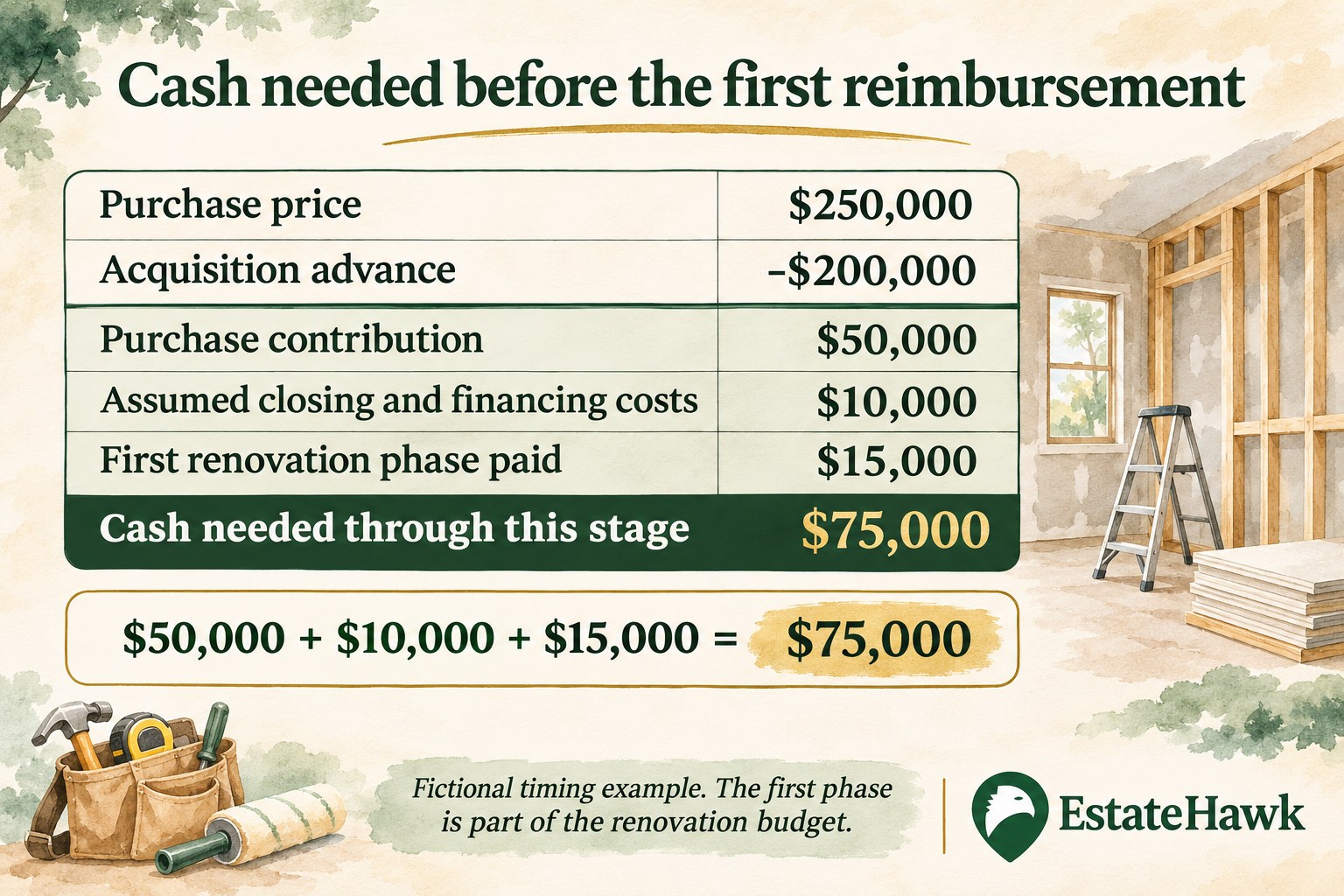
Because draws operate on reimbursement, an investor must float the capital between the payment of the contractor and the receipt of the wire.
Between scheduling the inspection, the inspector visiting the site, the inspector filing their report, the loan officer reviewing the lien waivers, the title company running the date-down, and the lender's wire desk releasing funds, the draw cycle routinely takes five to ten business days.
If an investor does not maintain twenty to thirty thousand dollars in liquid working capital to float the next trade phase while waiting for a pending draw wire, the job site grinds to a halt, subcontractors walk off to other jobs, and the project begins its descent toward maturity default.
Cost Structures: Origination Points, Dutch Interest, and Hidden Fees
The headline interest rate on a hard money term sheet is often the least important number in the entire transaction. A loan advertised at nine percent interest can easily cost you an effective annualized rate of eighteen to twenty-two percent once points, fees, and interest calculation mechanics are fully computed.
Origination Points: What Are You Actually Paying On?
Points are upfront loan fees paid at closing, where one point equals one percent. But one percent of what?
In an institutional mortgage, one point equals one percent of the loan amount. In hard money, you must scrutinize the loan agreement to determine whether the points are calculated on the Initial Acquisition Advance or the Total Committed Loan Facility.
Consider a transaction with a one-hundred-and-fifty-thousand-dollar purchase advance and a one-hundred-thousand-dollar construction holdback, making a two-hundred-and-fifty-thousand-dollar total loan facility. If the lender charges three points:
If points are charged on the acquisition advance, the fee is four thousand five hundred dollars.
If points are charged on the total loan commitment, the fee is seven thousand five hundred dollars.
That is a three-thousand-dollar difference deducted straight from your cash at the closing table before you have even turned a single doorknob.
The Dutch Interest Trap: Full Facility Versus As-Drawn Interest
This is the single most predatory structural term in the private debt industry, and it catches uneducated borrowers completely off guard.
When a lender charges As-Drawn Interest, interest accrues strictly on the capital that has actually been disbursed into the borrower's hands. At closing, you borrow one hundred and fifty thousand dollars for the acquisition, so you pay interest on one hundred and fifty thousand dollars. Two months later, you complete the framing and receive a twenty-five-thousand-dollar draw; from that day forward, you pay interest on one hundred and seventy-five thousand dollars.
When a lender charges Dutch Interest, interest accrues from day one on the entire total loan facility, including all undisbursed funds sitting in the lender's holdback account.
Look at the brutal mathematics:
You take out a three-hundred-thousand-dollar total loan at twelve percent interest for twelve months, consisting of two hundred thousand dollars for purchase and one hundred thousand dollars for renovation.
Under an as-drawn structure where draws are released evenly over six months, your average outstanding balance during the year might be two hundred and fifty thousand dollars, resulting in thirty thousand dollars in annual interest debt service.
Under a Dutch interest structure, the lender charges twelve percent on the full three hundred thousand dollars starting on the exact second the closing documents are signed. You are paying one percent per month, three thousand dollars every thirty days, on money that is sitting in the lender's bank account, money you cannot touch until you pass rigorous inspections months down the road.
That Dutch interest clause extracts an extra six thousand to nine thousand dollars in pure carrying cost straight out of your net profit margin.
Prepayment Penalties and Minimum-Interest Clauses
Many real estate investors pride themselves on speed. They plan to buy a property, complete renovations in forty-five days, sell it in ninety days, and pay off the loan in three months to minimize interest expense.
Not so fast.
Private loan notes frequently contain Minimum Interest Covenants or Yield Maintenance Provisions. A standard hard money note might stipulate that the lender is guaranteed a minimum of four, five, or six months of interest.
If you finish your project with blistering speed and pay off the loan in day seventy-five, the payoff demand will include a prepayment penalty equal to the unearned interest for months four, five, and six. The lender guaranteed their institutional yield when they underwrote the facility, and they will collect it regardless of how quickly you exit.
Junk Fees and Administrative Surcharges
Beyond interest and points, the private lending closing statement is often loaded with non-negotiable administrative charges:
Underwriting fees ranging from nine hundred and ninety-five to fifteen hundred dollars. Document preparation fees paid to the lender's closing attorney of twelve hundred to two thousand dollars. Processing fees of five hundred dollars. Wire transfer fees of seventy-five dollars per draw. Loan servicing setup fees of three hundred dollars. Flood certification and tax tracking fees.
Individually, these line items look manageable. Aggregated, they add five to eight thousand dollars of deadweight capital friction to your closing ledger.
Maturity Dates, Extensions, and the Default Interest Cliff
Hard money loans are short-term liquidity instruments. Standard loan terms range from six months to eighteen months, with twelve months being the industry norm for residential fix-and-flip projects.
What happens when your project hits month eleven, your contractor walked off the job two months ago, the city building department is demanding a revised structural engineering report for the foundation, and your contractual maturity date is thirty days away?
You are standing on the edge of the Default Interest Cliff.
The Contractual Maturity Date
The maturity date is not a gentle suggestion. It is a legally enforceable termination of credit. On the maturity date, the entire remaining principal balance, all accrued interest, all unpaid inspection fees, and all outstanding administrative charges become immediately due and payable in full.
A lender is under zero legal obligation to extend your loan simply because you ask nicely or because you have made your monthly interest payments on time.
Negotiating Formal Loan Extensions
Most institutional hard money lenders offer contractual extension provisions, but they come at a punishing price.
A standard extension clause permits the borrower to extend the maturity date for a period of three to six months, provided specific conditions are met:
The loan must be in good standing with zero thirty-day payment delinquencies.
The borrower must pay a formal Extension Fee, typically equal to one to two percent of the total loan commitment. On a three-hundred-thousand-dollar loan, an extension fee of two percent requires an immediate upfront cash payment of six thousand dollars.
The lender frequently requires a re-inspection of the property to verify that the project is not abandoned and may mandate that the borrower deposit additional cash reserves into the interest escrow account to guarantee debt service during the extension term.
Default Interest Rates and Judicial Foreclosure
If the loan matures and you do not qualify for or receive an extension, and you cannot deliver full payoff proceeds, the note enters Maturity Default.
The moment default occurs, the Default Interest Clause activates automatically.
Under standard commercial promissory notes, the interest rate escalates by an additional five to ten percent above the note rate, often hitting the state's commercial usury ceiling of eighteen to twenty-four percent per annum.
Furthermore, late fees of five to ten percent are assessed against the entire matured principal balance. Within sixty days of maturity default, the debt can swell by tens of thousands of dollars.
The lender issues a formal Notice of Default and Acceleration, demanding immediate payoff within ten to thirty days depending on state law. If payoff is not achieved, the lender's counsel initiates foreclosure:
In non-judicial foreclosure states (such as Texas, California, Georgia, and North Carolina), the trustee records a Notice of Default or Notice of Sale, publishes the auction date in the legal notices, and sells the property on the courthouse steps in as little as twenty-one to ninety days.
In judicial foreclosure states (such as New York, New Jersey, Florida, and Ohio), the lender files a formal commercial foreclosure complaint in the county court, records a Lis Pendens, and proceeds toward a judicial auction. While judicial foreclosure takes longer, the default interest clock continues to run at twenty-four percent every single day, completely consuming any remaining equity the investor had in the asset.
The Ultimate Payoff Mechanics: Closing the Facility Cleanly
When your renovation is complete and a retail buyer has secured a mortgage, or when you are executing a long-term Debt Service Coverage Ratio (DSCR) refinance to hold the property as a rental, you reach the final step: loan payoff.
Payoff is not as simple as wiring what you think you owe. It requires an audited Payoff Demand Statement from the lender.
Requesting the Formal Payoff Demand
Ten to fifteen business days before your scheduled closing, your settlement agent or title company must submit a formal Payoff Request to the hard money lender.
The lender's payoff department generates a detailed statement setting forth:
The exact principal balance outstanding.
Per-diem interest calculated down to the exact day of expected wire arrival.
Unreimbursed inspection fees or title date-down charges.
Extension fees or late fees, if applicable.
Escrow reconciliations: If the lender collected an upfront interest reserve or held undisbursed renovation funds, the payoff statement must credit those unused reserves against the total principal payoff balance.
A document release and reconveyance fee, covering the cost of preparing and recording the formal satisfaction instrument in the county land records.
Reviewing the Payoff Statement for Errors
Borrowers must audit this statement with extreme care. The most common errors include:
Failing to credit unused renovation holdbacks. If fifty thousand dollars remained undisbursed in the holdback account, that full fifty thousand dollars must be subtracted directly from the principal payoff figure.
Failing to credit unused interest reserves. If you pre-funded six months of interest at closing and exited the project in month four, the remaining two months of unearned interest must be refunded or credited on the payoff sheet.
Miscalibrated per-diem interest. Verify that the daily interest calculation accurately reflects the contractual day-count convention specified in the note (e.g., actual/360 versus actual/365).
Recording the Deed of Release or Satisfaction of Mortgage
Once the settlement agent wires the payoff funds, the transaction is not complete on the public records until the lender executes and records a formal release instrument.
Depending on the jurisdiction, this document is designated as a Satisfaction of Mortgage, Certificate of Discharge, Deed of Reconveyance, or Release of Deed of Trust.
The release instrument must reference the original recorded mortgage or deed of trust by book, page, or instrument number, and must be executed by an authorized officer of the lending entity with statutory notarial acknowledgments.
The borrower must confirm that the title company actually records this release in the county land records. If the release is never recorded, the hard money mortgage remains an active cloud on title, preventing any future sale or refinancing until an expensive quiet title action or release demand is prosecuted.
Hard Money Underwriting and Draw Audit Protocol
Before executing loan commitments, paying non-refundable due diligence deposits, or commencing structural construction, utilize this comprehensive operational framework to audit the financing structure:
Ledger columns: Capital Dimension; Verification Target; Primary Operational Failure; Governing Rule & Document Source
Regulatory Exemption
- Verification Target: Confirm valid business-purpose certification and absolute non-owner occupancy.
- Primary Operational Failure: Borrower moves into property, violating commercial exemption and triggering immediate loan fraud acceleration.
- Governing Rule & Document Source: 12 C.F.R. § 1026.3(a), CFPB Reg Z Business Exemption, Business-Purpose Affidavit.
Valuation Thresholds
- Verification Target: Audit purchase price, as-is value, approved construction budget, and projected ARV.
- Primary Operational Failure: As-is appraisal comes in low, slashing acquisition advance and requiring massive unbudgeted cash at closing.
- Governing Rule & Document Source: Independent BPO/Appraisal, 70% LTARV Guidelines, 85% LTC Calculation Sheets.
Interest Accrual Basis
- Verification Target: Verify whether interest accrues as-drawn on disbursed funds or as Dutch interest on total facility.
- Primary Operational Failure: Dutch interest charges full rate on undisbursed renovation holdbacks, draining thousands in net margin.
- Governing Rule & Document Source: Commercial Promissory Note Interest Clause, Loan Agreement Accrual Provisions.
Draw Reimbursement Structure
- Verification Target: Establish approved line-item SOW, draw inspection sequence, and processing timelines.
- Primary Operational Failure: Borrower exhausts working capital waiting ten days for draw wires; unpaid subcontractors abandon job site.
- Governing Rule & Document Source: Approved Scope of Work, Draw Schedule Addendum, Lender Servicing Guidelines.
Lien Waiver Protocol
- Verification Target: Require unconditional lien waivers for prior draws and title date-down searches before release.
- Primary Operational Failure: Subcontractor files mechanic's lien for unpaid labor, freezing all future construction draws instantly.
- Governing Rule & Document Source: State Mechanics' Lien Statutes, AIA Document G702/G703, Title ALTA 32/33 Endorsement.
Prepayment Covenants
- Verification Target: Audit minimum interest guarantees, yield maintenance rules, and prepayment penalties.
- Primary Operational Failure: Fast flip pays off in 60 days, triggering unexpected three-month unearned interest penalty at closing.
- Governing Rule & Document Source: Promissory Note Prepayment Section, Yield Maintenance Rider, Payoff Demand Rules.
Maturity & Default Escalation
- Verification Target: Identify contractual maturity date, extension fee percentages, and default interest spikes.
- Primary Operational Failure: Project delayed by city permits; loan matures and interest rate jumps from 10% to 24% default rate.
- Governing Rule & Document Source: Promissory Note Default Clause, Extension Option Rider, County Foreclosure Timelines.
Payoff Reconciliation
- Verification Target: Audit final payoff demand statement for credit of undisbursed holdbacks and interest reserves.
- Primary Operational Failure: Title company wires payoff based on gross facility, overpaying lender and surrendering unused holdback cash.
- Governing Rule & Document Source: Formal Payoff Demand Statement, Title Escrow Ledger, County Deed of Release/Reconveyance.
Case Study: The Marion County Draw Freeze and Dutch Interest Squeeze
To see how these private financing terms interact in a live renovation, examine the financial collapse that hit a residential investment partnership in Marion County, Indiana, involving a historic Queen Anne duplex on North Delaware Street in Indianapolis.
In March 2022, an investment entity formed by two partners, Bradley and Kevin, acquired the distressed duplex for one hundred and forty thousand dollars. They intended to execute a complete gut rehabilitation, convert the property into an executive short-term rental, and refinance the finished asset into a thirty-year DSCR loan.
They accepted a commercial bridge loan commitment from a regional private lending fund:
The total loan commitment was approved for three hundred and ten thousand dollars, consisting of a one-hundred-and-twenty-thousand-dollar acquisition advance (eighty-five percent of purchase price) and a one-hundred-and-ninety-thousand-dollar renovation holdback.
The headline interest rate was ten point five percent, with three origination points charged on the total three-hundred-and-ten-thousand-dollar facility (nine thousand three hundred dollars deducted upfront at closing).
The term was twelve months, interest-only, with an option for one three-month extension upon payment of a one point five percent extension fee.
Bradley and Kevin brought twenty-nine thousand three hundred dollars in cash to the closing table to cover the purchase price gap and closing fees, leaving them with exactly eighteen thousand dollars in their operating bank account for working capital.
Neither partner thoroughly audited the promissory note's fine print:
First, the loan note contained a full Dutch Interest provision. Bradley and Kevin were billed ten point five percent interest on the entire three hundred and ten thousand dollars starting on day one. Their monthly interest payment was exactly two thousand seven hundred and twelve dollars, rather than the one thousand and fifty dollars they had modeled for an acquisition-only balance.
Second, the loan agreement mandated strict milestone-based reimbursement draws, with zero advances permitted under any circumstance.
Work commenced in April. By late May, the framing, rough plumbing, and rough electrical were installed. Bradley and Kevin had paid their framing and mechanical subcontractors sixteen thousand dollars out of their eighteen thousand dollars of working capital, leaving their bank account virtually empty.
On June 2, they submitted their first draw request for thirty-eight thousand dollars:
The private lender dispatched an inspector, who noted that while the plumbing pipes were installed, the city plumbing inspector had not yet signed off on the rough mechanical inspection card. Furthermore, the framing crew had left several structural load-bearing headers unbolted pending an engineered drawing.
The lender's construction risk manager rejected the draw request in its entirety. The policy was absolute: no partial disbursements for rough trades without municipal inspection green tags and signed unconditional lien waivers from all subcontractors.
The subcontractors, unpaid for two weeks, walked off the job site and filed two mechanics' liens totaling twenty-two thousand dollars in the Marion County Recorder's Office.
When Bradley and Kevin attempted to resolve the municipal inspection issues, the private lender ran a title date-down, discovered the two recorded mechanics' liens, and officially froze the loan facility. Under the default covenants of the loan agreement, the presence of an unbonded mechanic's lien constituted an immediate event of default.
For four months, the project sat completely abandoned. Because the loan had entered covenant default, the lender invoked the default interest rate of eighteen percent on the full three-hundred-and-ten-thousand-dollar balance, while assessing late fees of five percent on every missed monthly payment. Bradley and Kevin's monthly carrying cost exploded to four thousand six hundred and fifty dollars.
By October, the loan reached month eight with zero construction progress. The total accrued interest, late fees, and legal notice charges exceeded thirty-four thousand dollars. The partners faced total financial ruin.
They were forced to bring in a rescue equity partner who injected sixty thousand dollars of emergency capital to bond off the mechanics' liens, pay the lender twenty thousand dollars in arrears, and fund the construction crews through to framing completion.
While the project was eventually finished and sold fourteen months later, the Dutch interest carrying costs, default penalties, extension fees, and rescue equity dilution completely wiped out Bradley and Kevin's projected eighty-thousand-dollar profit, resulting in a net cash loss of thirty-two thousand dollars. Had they negotiated an as-drawn interest structure and maintained a thirty-thousand-dollar working capital liquidity reserve, the initial inspection delay would have been a minor administrative adjustment instead of a financial catastrophe.
Case Study: The Hillsborough County Permitting Cliff and DSCR Takeout
A contrasting case study demonstrating strategic maturity management occurred in Hillsborough County, Florida, involving a mid-century single-family home in Tampa.
In January 2023, an experienced real estate developer named Marcus acquired an off-market property for two hundred and ten thousand dollars, with an estimated sixty-thousand-dollar light renovation and a projected ARV of three hundred and sixty thousand dollars.
Marcus secured a twelve-month hard money facility from a national private debt fund:
The total commitment was two hundred and fifty thousand dollars, structured as an eighty percent acquisition advance (one hundred and sixty-eight thousand dollars) and an eighty-thousand-dollar renovation holdback.
Marcus negotiated an As-Drawn Interest structure at nine point seven-five percent, with two points charged strictly on the acquisition advance, saving him two thousand dollars at closing compared to a total facility calculation.
Marcus began renovations in February. However, in April, when Marcus submitted plans to convert an attached utility room into a permitted master bathroom suite, the City of Tampa building department instituted an unexpected municipal permitting moratorium across the drainage basin, halting all new plumbing permit issuances for ninety days pending stormwater infrastructure reviews.
Marcus immediately recognized the danger: his twelve-month hard money clock was running, and three months of construction were instantly lost to municipal bureaucracy.
Rather than waiting for the eleventh month to panic, Marcus took proactive legal and financial steps in July (month seven):
He formally notified the hard money lender's portfolio management team of the municipal permitting delay, providing official correspondence from the City of Tampa.
He verified the exact contractual requirements for the three-month extension option in his loan documents: the option required sixty days' advance written notice, a one percent extension fee (twenty-five hundred dollars), and a verified project inspection showing all unpermitted interior work was completed to standard.
Marcus completed all non-plumbing renovation items, including roof replacement, exterior stucco, windows, and interior drywall in the main living areas, submitting two flawless draw requests backed by signed AIA lien waivers and city green tags for the structural work.
In October (month ten), the City of Tampa lifted the permitting moratorium and issued the plumbing permit. Marcus immediately exercised his contractual three-month extension option, paid the twenty-five-hundred-dollar fee, and pushed his maturity date from January 2024 to April 2024.
Simultaneously, Marcus initiated underwriting for his long-term exit: a thirty-year Debt Service Coverage Ratio (DSCR) rental refinance with an institutional takeout lender.
By starting the DSCR loan application four months before his extended hard money maturity date, Marcus allowed ample time for the DSCR appraisal, rent schedule analysis (Fannie Mae Form 1007), title commitment work, and underwriting approval.
In February 2024, the plumbing was certified, the master bathroom was completed, and the City of Tampa issued the final Certificate of Completion. Marcus submitted his final renovation draw of twenty-four thousand dollars, which was inspected and disbursed within six business days.
On March 18, 2024, three weeks before the extended hard money maturity deadline, Marcus closed his DSCR refinance loan at an appraised value of three hundred and seventy-five thousand dollars.
The title company requested a formal payoff demand from the hard money lender. Marcus audited the statement, verified that the unused thirty-five-hundred-dollar interest reserve was properly credited against the principal payoff, and wired the funds. The hard money mortgage was satisfied of record, Marcus extracted forty-two thousand dollars in tax-free cash-out equity, and the property was placed into service as a cash-flowing residential rental.
Strategic Execution: Protecting Capital and Enforcing Terms
Executing a profitable hard money transaction requires total operational discipline across every phase of the credit lifecycle.
First, never enter into a private loan agreement without modeling the borrowing costs under an extended holding period scenario. If your contractor tells you the renovation will take four months, underwrite your carrying costs based on eight months. If the project finishes early, the savings enhance your bottom line; if municipal inspectors, supply chain shortages, or weather events delay the job, your capital structure remains fully solvent.
Second, separate your construction contingency capital from your living expenses and primary operating cash. You must hold an unencumbered cash cushion of at least fifteen to twenty percent of the renovation budget in reserve, completely independent of the lender's holdback funds. This capital is what pays your trades, buys materials in advance, and bridges the gap during draw inspection cycles.
Third, maintain an unassailable digital paper trail for every single dollar disbursed on the job site. Demand detailed, line-item invoices from all general contractors, trade subcontractors, and material vendors. Pair every payment with a contemporaneous, signed statutory lien waiver. If a contractor threatens a dispute or delays work, an organized file containing dated photographs, written change orders, and verified payment releases gives you the absolute legal leverage required to bond off liens or replace personnel without freezing your loan facility.
Fourth, understand the lender's institutional perspective. Private lenders are not charitable organizations; they are fiduciary asset managers deployed to protect their investor capital. When problems arise, silence and evasion trigger immediate legal enforcement. Transparent, documented, and proactive communication supported by verified inspection milestones and clear recovery schedules turns a potentially catastrophic default into an orderly, successful loan payoff.