
Double Closing: Funding, Costs and Two-Sale Checks
Two contracts need two completion plans. Follow the funding sequence and separate a gross price spread from the money left after costs.
 By EstateHawk
On this page

Let's talk about the act of closing two real estate transactions in ten minutes. If you spend any time browsing wholesale real estate chatrooms, your first tip for hiding a massive assignment spread from an angry seller is almost always to do a double closing.
Who would have thought?
Buy a property from Seller A at nine o'clock in the morning, immediately sell it to Buyer C at nine-fifteen in the morning, use Buyer C's money to pay Seller A, and walk away with a forty-thousand-dollar profit check without the seller ever knowing how much you made. Truly dizzying heights of financial wizardry. So elegant in its simplicity. So breathtakingly catastrophic when the title company's underwriting counsel informs you at nine-twenty that simultaneous pass-through funding is strictly illegal under their underwriting manual, freezes both escrow files, and leaves you holding a purchase contract with zero cash to fund the acquisition.
While we're handing out revolutionary wisdom, let's make sure high-wire trapeze artists remember to practice without a safety net over a pit of hungry alligators. Let's make sure deep-sea divers remember to replace their lead diving weights with helium balloons.
No, "just double close with the end buyer's money" is advice manufactured for fake contract flippers. It belongs to the guru seminar ecosystem that pretends real estate title agencies operate like magic automated cash machines where legal deeds, escrow ledgers, and federal banking regulations dissolve into thin air whenever an investor wants to flip paper. Those people think an escrow officer is a casual co-conspirator whose sole job is to juggle unverified wires between unrelated transactions.
Here's what the podcast coaches and get-rich-quick courses will never explain: for an authentic settlement officer, title underwriter, or transactional attorney, reviewing a double closing isn't a casual rubber stamp, it's an obsession they have zero control over.
If you let an authentic title underwriter anywhere near a short-interval back-to-back transaction, their brain completely disconnects from all standard conversational pleasantries. Normal people look at the transaction and see a clever forty-thousand-dollar profit spread. The document obsessive could not care less about the spread. They want to know whether the intermediate buyer has independent, fully verified wet funds to close the A-to-B leg, whether Essent Title or Aurum Title underwriting bulletins governing short-interval transactions require documented proof of funding sources, whether the end buyer's institutional lender enforces mandatory title seasoning rules under federal FHA guidelines, and whether the county recorder charges dual documentary transfer taxes on both recorded conveyances.
In fact, if you leave that researcher unsupervised at two in the morning with an open browser, they won't even be reviewing settlement statements at all. They will have fallen headfirst into an algorithmic rabbit hole on a Romanian military vehicle salvage portal, studying auction listings for a decommissioned Soviet GSP-55 heavy amphibious tracked self-propelled ferry. They will spend two solid hours examining technical blueprints of its twin 240-horsepower tank diesel engines and deployable outer pontoon hulls, analyzing how two mirrored tracked vehicles coupled together in mid-stream to transport fifty-two-ton battle tanks across the Danube River at seven miles an hour, calculating whether its dual twenty-four-inch marine water propellers could maneuver through floating spring ice floes without snapping a bronze shear pin, and reading translated forum flame wars from 2011 about whether bilge pump impeller seals corrode when exposed to brackish river sediment.
Then the Instant Gratification Monkey at the back of their brain gets hit with a cold shock of pure adrenaline. The Rational Decision-Maker kicks down the door, drags them away from Soviet amphibious heavy tracked combat ferries, and slams their face back into the escrow settlement sheet. Because right there on the closing instructions is an unaddressed eleven-thousand-dollar transactional cost deduction that is about to wipe out forty percent of the wholesaler's anticipated net profit.
Welcome to the complex, heavily scrutinized, and expensive legal machinery of the double closing.
The foundational trap that catches novice real estate investors completely off guard begins with a total failure to understand the anatomical structure of a double closing.
A double closing is not an assignment of contract.
In an assignment of contract, there is only one real estate sale. Seller A conveys fee simple legal title directly to Buyer C. The intermediate investor, Party B, simply assigns their executory contract rights to Buyer C in exchange for an assignment fee, which appears as a single line item on the settlement statement.
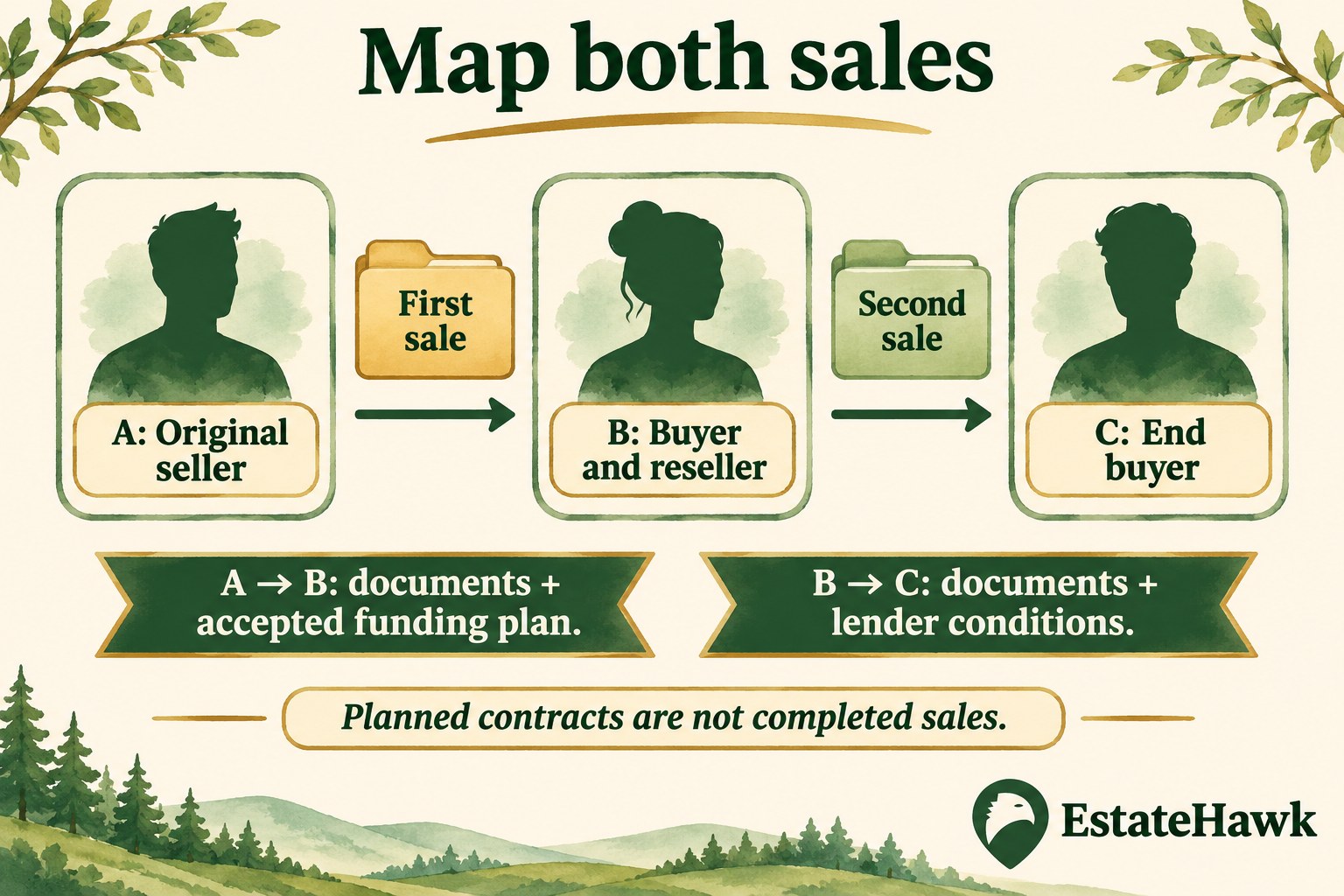
In a double closing, there are two entirely separate, legally distinct real estate transactions occurring in rapid sequence.
Transaction One: The A-to-B Sale. Seller A is the seller. Party B is the buyer. A binding purchase contract is executed. Legal title transfers from Seller A to Party B. A grant deed or warranty deed is executed, delivered, and recorded.
Transaction Two: The B-to-C Sale. Party B is now the seller. Buyer C is the buyer. A completely separate, second purchase contract is executed. Legal title transfers from Party B to Buyer C. A second grant deed or warranty deed is executed, delivered, and recorded.
Look at the monumental legal reality of that sequence.
In Transaction Two, Party B is not selling a contract. Party B is selling real estate that they legally own.
Because Party B actually takes legal title to the property, they completely bypass the legal arguments surrounding unlicensed real estate brokerage that plague contract assignments in states like Illinois, Texas, and Oklahoma.
However, taking legal title introduces the single most explosive obstacle in modern wholesale real estate: the funding sequence.
Let us dismantle the great myth of simultaneous funding.
Historically, in the loose regulatory environment of the early 2000s, title companies permitted what the industry called simultaneous funding, wet funding, or pass-through funding.
Party B would bring zero dollars to the closing table. The title company would wait for Buyer C to wire their purchase money into escrow. The title company would then take Buyer C's money, use it to pay Seller A the purchase price for the A-to-B leg, pay off Seller A's mortgage, distribute the deed from A to B, immediately distribute the deed from B to C, and hand Party B the cash difference.
Today, that practice is virtually dead across the entire American title insurance industry.
Major national title insurance underwriters, including Fidelity National Title, First American, Old Republic, Stewart Title, and Essent Title, have issued strict underwriting bulletins explicitly prohibiting their settlement agents from using Buyer C's funds to close the A-to-B transaction.
Under modern title underwriting standards, Transaction A-to-B must be completely, independently funded before Transaction B-to-C can legally proceed.
If Party B does not have the cash sitting in their bank account to purchase the property from Seller A, Party B cannot close.
This brings us to the necessity of transactional funding.
Transactional funding, commonly referred to as same-day funding or flash funding, is specialized short-term capital provided by private lenders specifically designed to fund the A-to-B leg of a double closing.
The transactional lender wires the full purchase amount required for the A-to-B purchase into escrow on the morning of closing. Transaction A-to-B closes and records.
Then, Transaction B-to-C closes immediately afterward using Buyer C's funds.
The title company immediately wires the repayment balance back to the transactional lender, plus the lender's financing fee, and disburses the net profit to Party B.
The transactional loan lasts for only a few hours.
However, transactional funding is not free. Specialized lenders charge origination points and administrative fees, typically one to two percent of the loan balance, with minimum fees ranging from fifteen hundred to three thousand dollars, plus wire fees and document preparation charges.
Now look at the arithmetic of double closing costs: the double transaction penalty.
This is where novice wholesalers watch their anticipated profits vanish into thin air.
In a contract assignment, Party B pays zero closing costs. Buyer C typically pays all title and escrow fees.
In a double closing, because there are two distinct real estate sales, Party B is liable for transaction costs on both legs of the sequence.
Let us walk through a detailed, real-world mathematical analysis:
Suppose Party B negotiates to buy a property from Seller A for $180,000.
Party B contracts to resell the property to Buyer C for $210,000.
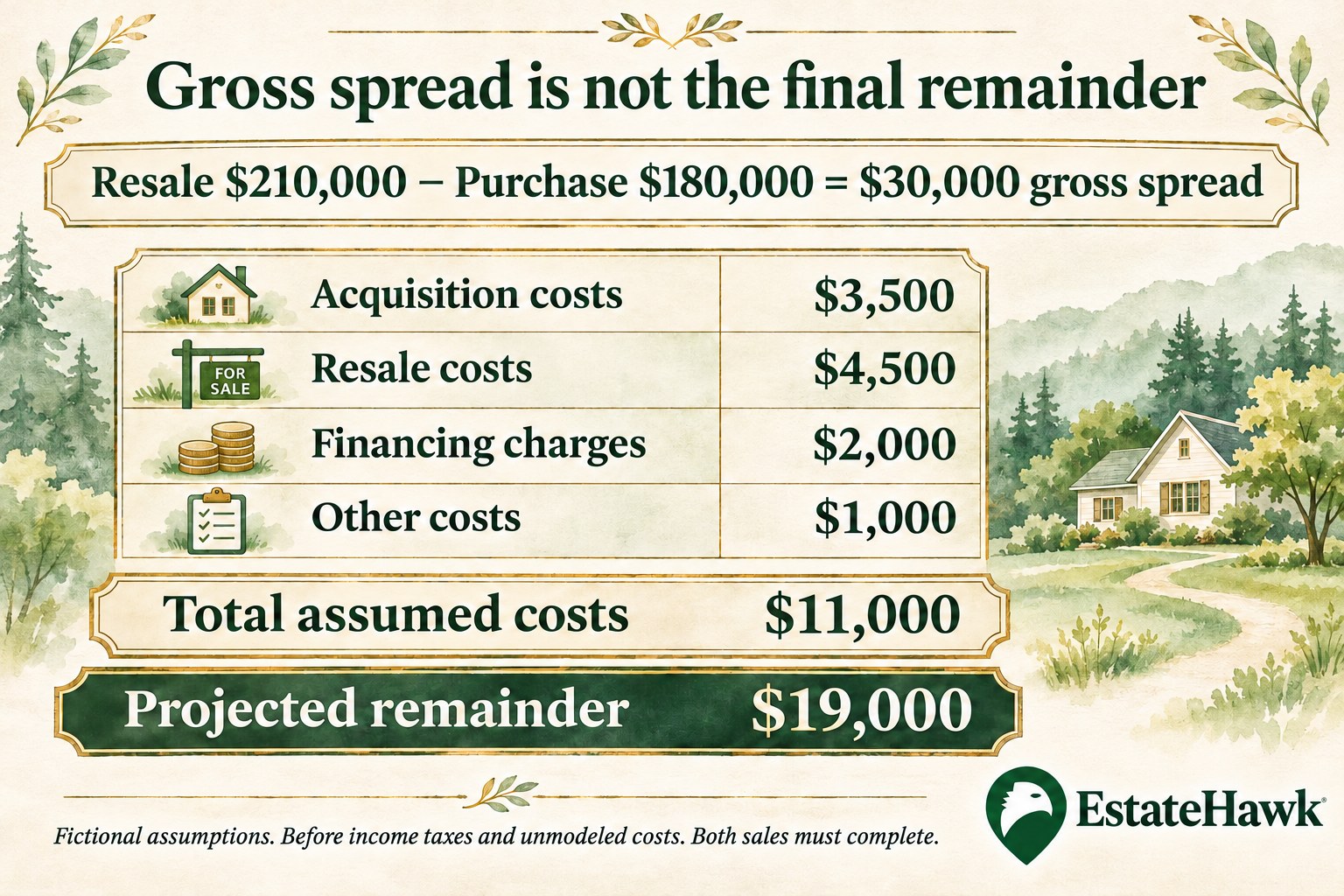
The gross price spread is $30,000.
An amateur investor looks at that spread and assumes they will deposit a thirty-thousand-dollar profit check.
Now let us audit the actual settlement ledgers:
First, look at the A-to-B Leg.
Party B is the buyer. Party B must pay buyer-side settlement charges:
Title search and title examination fees: $800.
Escrow and settlement closing fees: $1,200.
Deed recording fees and municipal tax certifications: $300.
Prorated county property taxes and insurance reserves: $1,200.
Total A-to-B closing expenses allocated to Party B: $3,500.
Second, look at the B-to-C Leg.
Party B is now the seller. In most American real estate markets, standard contractual custom dictates that the seller pays for the owner's title insurance policy and state/county documentary transfer taxes:
Owner's policy of title insurance issued to Buyer C: $1,600.
Seller-side escrow settlement fee: $1,200.
State and county documentary transfer taxes: $1,400.
Municipal compliance inspections and recording fees: $300.
Total B-to-C closing expenses allocated to Party B: $4,500.
Third, look at financing costs.
Party B used a transactional lender to provide the $180,000 flash loan to close the A-to-B leg:
Transactional lender origination fee (one percent plus wire fee): $2,000.
Fourth, look at entity planning and legal document review:
Independent real estate attorney fee to review both contracts and escrow instructions: $1,000.
Now add up the total transactional costs:
A-to-B closing costs: $3,500.
B-to-C closing costs: $4,500.
Transactional financing fee: $2,000.
Legal review fee: $1,000.
Total Transactional Frictional Expenses: $11,000.
Now calculate the true net profit:
Gross price spread: $30,000.
Minus transactional expenses: $11,000.
Actual Net Cash Profit: $19,000.
Notice what happened. Frictional closing costs, dual title fees, transfer taxes, and financing charges devoured eleven thousand dollars, representing thirty-six percent of the gross spread.
If you model a double closing based on gross spread without accounting for dual closing costs, you are engaging in financial self-deception.
Now consider the ultimate nightmare scenario of a double closing: what happens when Buyer C fails to close?
This is the catastrophic risk that keeps seasoned real estate attorneys awake at night.
Party B signs the paperwork on the A-to-B transaction. The transactional lender wires $180,000 into escrow. The deed from Seller A to Party B is executed, delivered, and recorded.
Seller A walks away with their money.
Party B is now the legal, fee simple owner of the house.
Party B sits in the title company conference room, waiting for Buyer C's funds to arrive to complete the B-to-C sale.
At eleven o'clock, Party B's phone rings.
It is Buyer C's mortgage lender. The lender's underwriting department conducted a final verbal verification of employment and discovered that Buyer C was laid off from their job yesterday afternoon. The lender refuses to fund the mortgage.
Buyer C's transaction is dead. Buyer C cannot close.
Look at the absolute disaster Party B is now facing:
Party B legally owns the house.
Seller A is gone.
Buyer C is gone.
And Party B owes a private transactional lender $180,000 in cash, under a loan agreement that mandates full repayment within twenty-four to forty-eight hours.
Transactional lenders are not long-term mortgage companies. They provide flash capital.
When a double closing fails, the transactional lender's default provisions trigger immediately. The interest rate spikes to default penalty rates of eighteen to twenty-four percent annualized. The lender charges daily extension fees of several hundred dollars, and if Party B cannot refinance the property or secure emergency bridge capital within days, the transactional lender will initiate foreclosure proceedings, seize Party B's earnest money, and pursue them for damages.
Furthermore, Party B is now responsible for the vacant house: paying daily interest carry, paying property taxes, paying hazard insurance, and securing the building against vandalism.
You must never execute the A-to-B leg of a double closing unless Buyer C's financing is fully firm, non-contingent, clear to close, and Buyer C's wire is already sitting verified in the title company's escrow account.
Now consider lender seasoning rules and title commitments.
If Buyer C is obtaining conventional, FHA, or VA mortgage financing, Party B faces another massive regulatory hurdle: title seasoning.
Under federal Federal Housing Administration guidelines (24 CFR Section 203.37a), the FHA enforces strict anti-flipping rules:
If a property is resold within ninety days of the seller acquiring title, the property is completely ineligible for FHA-insured financing. An FHA buyer cannot purchase a home from a seller who has owned the property for less than ninety days.
If the property is resold between ninety-one and one hundred and eighty days, and the resale price is one hundred percent or more above the seller's acquisition price, the lender must require a second independent appraisal and extensive documentation justifying the price increase.
Conventional mortgage lenders operating under Fannie Mae guidelines also scrutinize short-interval flips. If an underwriter sees that the seller took title thirty minutes before reselling the property for a forty-thousand-dollar markup, the underwriter will demand proof of substantial physical improvements or flag the file for predatory flipping fraud.
If Buyer C is using bank financing, a double closing will almost certainly fail unless Buyer C is using non-institutional cash or specialized private money that permits same-day title transfers.
Let us walk through an educational case study that demonstrates how an unverified double closing completely imploded.
Consider an investor named Derek who negotiates a purchase agreement to buy an older home on Crestview Lane from an out-of-state heir for $175,000.
Derek markets the property and finds a cash investor named Elena who agrees to purchase the home for $215,000.
Derek wants to do a double closing to conceal his forty-thousand-dollar profit spread from the heir.
Derek opens escrow at a small local title agency. Derek tells the title officer that he will be doing a double closing on Thursday morning. Derek does not hire a transactional lender because he assumes he can use Elena's $215,000 wire to pay the heir the $175,000 purchase price.
On Thursday morning, Seller A signs the A-to-B deed.
Derek sits down to sign his paperwork. Derek asks the title officer to disburse the funds from Elena's wire to Seller A.
The title officer stops immediately.
The title officer informs Derek that their title insurance underwriter, First American Title, strictly prohibits simultaneous pass-through funding. Under underwriting rules, Derek must wire $175,000 plus closing costs from his own independent bank account to close the A-to-B purchase before Elena's funds can be touched.
Derek is completely dumbfounded. He does not have $175,000. He has $4,000 in his checking account.
The closing is halted.
Seller A becomes furious, suspects something underhanded is occurring, and threatens to cancel the contract and retain Derek's two-thousand-dollar earnest money deposit.
Derek frantically calls hard money lenders. He finds a private transactional lender who agrees to provide emergency flash funding, but because of the rush emergency nature of the request, the lender charges a five-thousand-dollar flat fee.
Derek wires the fee, the transactional lender funds the $175,000, and the A-to-B deed is recorded at two in the afternoon.
Then Derek attempts to close the B-to-C transaction with Elena.
Elena's closing attorney reviews the updated title commitment. The attorney notices that Derek took title three hours earlier and points out that the property is encumbered by an unrecorded municipal code enforcement notice regarding an overgrown rear retaining wall that Derek never disclosed to Elena.
Elena refuses to sign the final closing documents until the municipal violation is resolved and demands a ten-thousand-dollar price reduction.
Derek is trapped. His transactional loan must be repaid by Friday at five o'clock, or default interest of twenty percent will begin accruing at one hundred dollars a day.
Derek has zero leverage. He is forced to accept Elena's ten-thousand-dollar price reduction.
Look at the final financial reckoning:
Gross price spread: $40,000.
Minus price concession to Elena: $10,000.
Minus dual title, escrow, and transfer taxes: $8,200.
Minus emergency transactional lending fees: $5,000.
Total Frictional Deductions: $23,200.
Derek's forty-thousand-dollar profit collapsed to $16,800, and he endured two days of sheer panic that nearly resulted in a catastrophic loan default.
Derek lost over twenty-three thousand dollars of his anticipated spread because he assumed simultaneous funding was permitted and failed to audit his closing costs in advance.
Now let us examine the four conversational questions that constantly arise whenever property investors evaluate double closings.
The first question involves funding mechanics: Can an intermediate buyer use the end buyer's purchase money to fund the first purchase in a double closing?
No. That practice, historically known as simultaneous funding or pass-through funding, is strictly prohibited by nearly every major title insurance underwriter in the United States today. Title underwriters mandate that Transaction A-to-B must be completely, independently funded with verified, seasoned funds before Transaction B-to-C can be executed. If the intermediate buyer does not possess sufficient cash reserves, they must secure independent transactional funding from a specialized lender to fund the initial acquisition.
The second question concerns legal compliance: Does executing a double closing completely eliminate the need for real estate licensing or statutory disclosures?
Never assume that a transaction structure eliminates legal duties. While taking legal title in a double closing means the investor is selling property they own, which avoids the specific unlicensed brokerage claims associated with marketing contract assignments, it does not exempt the transaction from broader legal requirements. Investors must still comply with statutory seller disclosure mandates, provide honest answers regarding property condition, and comply with state-specific wholesale regulations, such as those enacted in Oregon, Texas, and Oklahoma. Deceptive conduct, misleading representations, or hiding material property defects will expose an investor to civil liability regardless of the closing structure.
The third question involves transaction costs: Why are closing costs significantly higher in a double closing compared to a standard contract assignment?
Closing costs are substantially higher because a double closing involves two completely separate, legally recorded real estate conveyances. In a standard contract assignment, there is only one closing, and the end buyer typically pays all settlement fees. In a double closing, the intermediate investor is a buyer in the first transaction and a seller in the second transaction. This creates dual escrow settlement fees, dual title examination charges, dual recording fees, two sets of title insurance premiums, and in many jurisdictions, dual state and county transfer taxes levied twice on the same real estate in the same afternoon, alongside transactional lender financing points.
The fourth question addresses technology: Where do modern property intelligence platforms and automated workflow tools fit into double closing research?
Modern property intelligence software platforms are invaluable for conducting preliminary title research, verifying legal ownership on recorded deeds, tracking parcel boundaries, and identifying prior mortgages and liens. However, digital tools cannot secure transactional financing, interpret complex title underwriter closing manuals, or draft legally binding dual escrow instructions. Software intelligence must always be paired with an experienced, investor-friendly closing attorney, a licensed title insurance underwriter, and verified proof of independent funding before executing back-to-back purchase agreements.
When you structure a double closing, approach every document with absolute professional rigor.
Verify that your title company actively supports short-interval transactions and understands the two-sale structure. Secure your transactional funding in advance with written loan commitments, calculate your dual closing costs and transfer taxes with mathematical precision, and never execute the first acquisition until your end buyer's funds are fully verified in escrow.
Operating with that level of legal and financial discipline is what protects your capital, preserves your equity, and ensures that your double closings generate verified profits rather than devastating financial defaults.