
Seller Financing: Terms and Risks to Check Before Buying
A monthly payment is only one term. Understand what happens to title, principal and the remaining balance, then confirm the legal and closing requirements.
 By EstateHawk
On this page

Let's talk about the act of buying a house without a bank. If you spend five minutes listening to creative real estate financing influencers on social media, your first tip when credit markets tighten is almost always to find a tired landlord and negotiate seller financing.
Who would have thought?
Skip the bank, skip the intrusive mortgage underwriters, skip the tax return audits, and simply mail a check directly to the seller on the first of every month like you're paying a friendly uncle for an old lawnmower. Truly revolutionary financial liberation. So elegant in its simplicity. So exquisitely horrifying when you discover thirty-six months into the arrangement that your agreement contained a hidden three-year balloon payment clause, the seller still owes two hundred thousand dollars to an institutional lender whose mortgage has an active due-on-sale clause, and your contract was drafted as an unrecorded installment land contract that allows the seller to evict you and keep every penny of your down payment.
While we're distributing Nobel-prize-winning wisdom, let's make sure deep-sea saturation divers remember to replace their steel diving helmets with wicker baskets. Let's make sure space shuttle pilots remember to check orbital trajectory by holding a wet thumb out the cockpit window.
No, "just pay the seller each month" is advice manufactured for fake property buyers. It belongs to the guru crowd who believe that private real estate debt operates on a casual honor system where nobody ever needs an attorney, nobody checks title encumbrances, and nobody ever reads the fine print of a promissory note. Those people think an owner-financed purchase is a cozy handshake deal that frees you from the harsh realities of real estate lending law.
Here's what the creative financing bootcamps and superficial advice videos will never explain: for an authentic real estate transactional attorney, escrow underwriter, or private debt specialist, auditing a seller-financed transaction isn't a casual contract review, it's an obsession they have zero control over.
If you let an authentic debt obsessive anywhere near a seller-financing proposal, their brain completely disconnects from all standard conversational pleasantries. Normal buyers look at the deal and celebrate skipping a traditional bank application. The document obsessive could not care less about skipping the bank. They want to know whether the conveyance transfers fee simple legal title via a recorded warranty deed or traps the buyer in an executory contract for deed, whether the promissory note complies with federal Consumer Financial Protection Bureau Regulation Z seller-financer exclusions under the Dodd-Frank Act, whether the seller's underlying mortgage triggers federal acceleration under 12 U.S.C. Section 1701j-3, and whether monthly debt service is administered through a licensed, third-party loan servicing corporation.
In fact, if you leave that researcher unsupervised at two in the morning with an open browser, they won't even be reviewing promissory notes at all. They will have fallen headfirst into an algorithmic rabbit hole on an Eastern European military machinery salvage forum, studying auction listings for a decommissioned Soviet PTS-M heavy amphibious tracked transporter. They will spend two solid hours examining technical blueprints of its 350-horsepower V-12 diesel engine and massive rear marine water propellers, analyzing how its watertight riveted steel boat hull allowed it to transport ten tons of artillery across storm-tossed coastal river estuaries at eight miles an hour, calculating whether its wide steel track pads would chew up an asphalt suburban driveway without snapping a torsion bar, and reading translated forum flame wars from 2011 about whether propeller shaft packing gland seals dry out and flood the engine bilge when stored in unheated hangars.
Then the Instant Gratification Monkey at the back of their brain gets hit with a cold shock of pure dread. The Rational Decision-Maker kicks down the door, drags them away from Soviet amphibious heavy tracked transports, and slams their face back into the seller-financing promissory note. Because right there in paragraph four is a balloon payment demand of two hundred and fifteen thousand dollars due in thirty-six months, and the buyer has a five-hundred-and-eighty credit score that will make bank refinancing completely impossible.
Welcome to the intricate, high-stakes legal reality of Seller Financing.
The foundational trap that destroys buyers in seller-financed transactions begins with a complete failure of structural definition.
What is seller financing?
Seller financing, commonly referred to as owner financing, occurs when the property seller acts as the mortgage bank. Instead of the buyer bringing a mountain of cash from a traditional institutional mortgage lender to pay the seller in full on closing day, the seller agrees to extend credit to the buyer for some or all of the purchase price.
The buyer makes a down payment in cash, and the remaining balance is repaid to the seller over time according to the terms of a legally binding promissory note.
However, saying "seller financing" tells you zero about how the transaction is actually legally structured.
In American real estate law, seller-financed transactions split into two fundamentally opposing legal architectures:
Architecture number one is the Gold Standard: Deed and Security Instrument.
Under this proper, legally protective structure, two events occur simultaneously at the closing table:
First, the seller executes, delivers, and records a formal Warranty Deed or Grant Deed, conveying full fee simple legal and equitable title directly to the buyer on day one. The buyer becomes the official legal owner on county land records.
Second, the buyer signs two separate documents: a Promissory Note, which establishes the personal debt obligation, and a Mortgage or Deed of Trust, which is recorded in the county land records as a security lien against the real estate.
In Texas, for example, the Texas Real Estate Commission provides a standardized Seller Financing Addendum (Form 26-8) specifically designed around this structure, linking an explicit promissory note to a recorded deed of trust.
If the buyer pays faithfully, the seller records a release or deed of reconveyance. If the buyer defaults on their payments, the seller must follow statutory state foreclosure procedures, such as non-judicial trustee foreclosure or judicial sheriff sales, respecting the buyer's equitable rights and statutory cure periods.
Now look at Architecture number two: the Predatory Land Contract trap.
In many states across the Midwest and South, sellers attempt to structure seller financing as an installment land contract, commonly known as a Contract for Deed, Bond for Title, or Agreement for Deed.
Under an installment land contract, the seller does NOT convey legal title to the buyer on day one.
The seller retains fee simple legal title in their own name. The deed remains locked in the seller's safe. The buyer receives only what the law calls equitable title, possessing the property while making monthly installment payments.
The contract specifies that the seller will execute and deliver the deed only after the buyer has made every single monthly payment for twenty or thirty consecutive years.
Why is an installment land contract so immensely dangerous for a buyer?
Because of statutory forfeiture clauses.
In many states, if a buyer under an installment land contract misses a single monthly payment, the seller does not have to file a formal mortgage foreclosure lawsuit. The seller simply serves a statutory forfeiture notice, cancels the contract, evicts the buyer through summary landlord-tenant court like an ordinary delinquent renter, and keeps the buyer's down payment, every single monthly payment made over the years, and all equity generated by the buyer's home improvements.
Never purchase real estate under an installment land contract or contract for deed without an experienced real estate attorney restructuring the transaction into a recorded deed and deed of trust.

Now let us examine the repayment mechanics: the deadly balloon payment ambush.
This is the single most common weapon used by predatory sellers to wipe out amateur buyers.
When an investor evaluates a promissory note, they look at the monthly payment.
The seller says: "Your purchase price is $250,000. Put down $25,000 in cash. I will finance the remaining $225,000 at six percent interest. Based on a thirty-year amortization schedule, your monthly principal and interest payment is only $1,348.99."
The buyer runs the numbers. $1,348 a month looks completely affordable. The buyer signs the note.
The buyer fails to read the maturity clause.
The promissory note states: "Principal and interest payments shall be calculated based on a thirty-year amortization schedule. However, the entire remaining unpaid principal balance, together with all accrued interest, shall become fully due and payable in one single balloon payment on the thirty-sixth monthly payment date."
Look at the terrifying financial arithmetic of that clause:
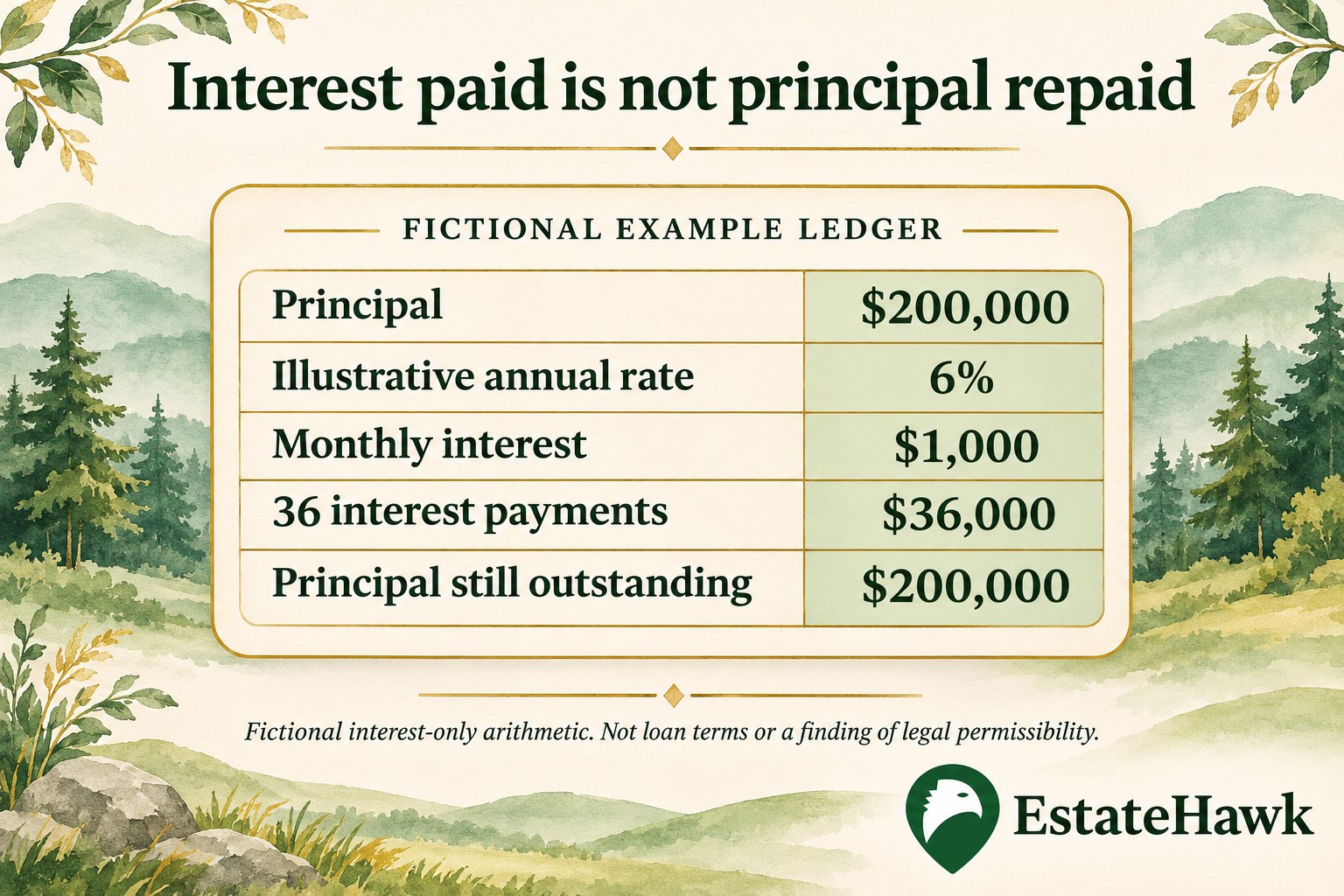
Over the first thirty-six months, the buyer faithfully pays $1,348.99 every single month, totaling $48,563 in payments.
Because of the front-loaded nature of loan amortization schedules, thirty-nine thousand dollars of that money was consumed by interest. The buyer paid down only nine thousand dollars of principal.
At month thirty-six, the remaining unpaid loan balance is $215,800.
The balloon payment matures. The seller demands $215,800 in certified cash.
The buyer does not have $215,800 in cash.
The buyer rushes to a mortgage broker to apply for a bank refinance.
Then reality strikes.
Perhaps the national mortgage interest rates doubled during those three years. Perhaps the local housing market experienced a downturn, and the house appraises for only $200,000. Or perhaps the buyer suffered a temporary job disruption and their credit score dropped to 600.
No institutional mortgage lender will approve the loan.
The buyer cannot refinance. The thirty-sixth month expires. The buyer is in formal financial default.
The seller files a foreclosure action, forecloses on the property, takes the house back, and the buyer loses their twenty-five-thousand-dollar down payment, three years of monthly payments, and all accumulated sweat equity.
If you accept a seller-financed note with a balloon payment, you must have a guaranteed, legally viable exit strategy, or demand a fully amortizing fifteen-year or thirty-year note with zero balloon maturities.
Now consider the second massive legal hazard: the underlying mortgage and the Due-on-Sale Clause.
What happens if the seller does not own the property free and clear?
In millions of seller-financed transactions, the seller currently has an active, outstanding institutional mortgage on the house, held by Wells Fargo, Chase, or an FHA servicer.
The seller proposes a wraparound mortgage, universally known as a "wrap."
The buyer signs a note to the seller for $200,000. The seller owes $150,000 on their underlying mortgage to Chase. The buyer pays the seller $1,400 a month, and the seller promises to take $1,000 of that money and pay Chase every month, pocketing the $400 spread.
Look at the dual landmines in that arrangement:
Landmine number one: The Garn-St. Germain Depository Institutions Act of 1982 (12 U.S.C. Section 1701j-3).
Under federal law, virtually every conventional, FHA, and VA mortgage in the United States contains an ironclad Due-on-Sale Clause.
The clause explicitly states that if the borrower transfers title, conveys an equitable interest, or enters into an installment land contract without the lender's prior written consent, the lender has the contractual right to accelerate the entire mortgage debt, declaring the full $150,000 loan balance immediately due and payable within thirty days.
If the lender discovers the unpermitted transfer, through an updated hazard insurance policy, a change in tax billing, or a recorded deed, the lender will issue a formal demand for immediate acceleration. If the loan cannot be paid off in thirty days, the bank will initiate foreclosure, wiping out the buyer's interest.
Landmine number two: Seller default.
In a wraparound mortgage, the buyer pays the seller. The buyer relies entirely on the seller's honesty to pay the underlying bank.
What happens if the seller runs into financial hardship, takes the buyer's $1,400 monthly payment, spends it on personal medical bills or gambling, and stops paying Chase?
Chase does not send foreclosure notices to the buyer; Chase sends notices to the seller.
The buyer continues paying faithfully every month, completely unaware that the underlying mortgage is in default, until a deputy sheriff knocks on the front door with a Notice of Foreclosure Sale.
If you enter into a wraparound transaction, the transaction must mandate the use of an independent, third-party loan servicing company that collects the buyer's payment, pays the underlying institutional mortgage directly, and disburses only the remaining spread to the seller.
Now consider federal and state regulatory constraints: Dodd-Frank and the SAFE Act.
Amateur investors believe that private individuals can draft whatever loan terms they want without government interference.
That is completely false.
Under the Dodd-Frank Wall Street Reform and Consumer Protection Act, codified in Consumer Financial Protection Bureau Regulation Z (12 CFR Section 1026.36), federal law strictly regulates seller financing on residential properties intended for consumer owner-occupancy.
To provide seller financing without being classified as an illegal, unlicensed mortgage loan originator, a private seller must qualify under specific statutory exclusions:
The One-Property Exclusion: A natural person, estate, or trust financing only one residential property in any twelve-month period. Under this federal exclusion, the seller cannot have constructed the home, the loan must have a fixed interest rate or an adjustable rate with strict caps, and balloon payments are severely restricted.
The Three-Property Exclusion: A person or entity financing three or fewer properties in a twelve-month period. Under this exclusion, the loan must be fully amortizing with zero balloon payments, and the seller is legally mandated to determine and document the borrower's reasonable Ability to Repay (ATR) prior to closing.
Furthermore, state SAFE Act licensing statutes mandate that individuals who exceed statutory thresholds must be licensed as professional mortgage loan originators. Violating these federal and state lending rules can render the promissory note legally unenforceable and expose the seller to statutory damages and civil penalties.
Let us walk through an educational case study that demonstrates how an unverified seller-financing structure destroyed a buyer.
Consider a buyer named Marcus who wants to purchase a rural residential home on Timberline Ridge for $260,000. Marcus has ten years of stable self-employment income, but because of tax deductions, he cannot qualify for a conventional bank mortgage.
The seller, an older gentleman named Arthur, offers seller financing. Arthur tells Marcus: "Pay me thirty thousand dollars down, and I will finance the remaining $230,000 at six percent interest. Your monthly payment will be $1,378. No banks, no closing costs, simple paperwork."
Marcus is thrilled. He wires $30,000 to Arthur.
Arthur pulls out a pre-printed document titled "Contract for Deed" that Arthur downloaded from an online legal template website. Arthur and Marcus sign the agreement at a local bank counter before a notary.
Marcus does not hire a real estate attorney. Marcus does not order a title search.
Marcus moves into the home, replaces the carpet, paints the exterior, and pays Arthur $1,378 on the first of every month for three years.
In month thirty-six, Marcus receives a formal letter from an attorney representing Arthur.
The letter points to paragraph twelve of the Contract for Deed, which contained an explicit three-year balloon payment clause. The letter states that the remaining loan balance of $219,400 is due in full within thirty days.
Marcus is completely blindsided. Marcus assumed he had a thirty-year loan because the payment was calculated on a thirty-year schedule.
Marcus rushes to regional banks to apply for a mortgage.
However, because the transaction was an unrecorded Contract for Deed, Marcus's name was never recorded on the county vesting deed. Arthur still owns the legal title. Institutional banks refuse to refinance a property that Marcus does not legally own.
Furthermore, Marcus pulls the county land records for the first time and discovers a horrifying secret: Arthur has an active, unreleased $140,000 first mortgage on the property held by Bank of America, which Arthur never disclosed.
Marcus cannot pay the $219,400 balloon payment.
Arthur's attorney serves Marcus with a statutory Notice of Forfeiture under state installment land contract laws.
Because Marcus held an executory contract rather than a recorded deed, the court cancels the agreement. Marcus is evicted from the property.
Arthur keeps Marcus's $30,000 down payment, keeps the forty-nine thousand dollars in monthly installment payments Marcus made over three years, and takes back the renovated house.
Marcus lost over seventy-nine thousand dollars in cash capital, lost his home, and lost three years of his life because he accepted an unrecorded Contract for Deed with an unverified balloon payment.
Now let us examine the four conversational questions that arise whenever property investors evaluate seller financing.
The first question involves contract structures: Is seller financing the exact same thing as a rent-to-own agreement or a Contract for Deed?
No. They represent completely different legal architectures. True, protective seller financing involves executing and recording a Warranty Deed conveying full fee simple legal ownership to the buyer at closing, with the seller securing their debt through a recorded Mortgage or Deed of Trust. A Contract for Deed, or installment land contract, is an executory contract where the seller retains legal title until the final payment is made decades later, exposing the buyer to severe statutory forfeiture and loss of equity. A rent-to-own agreement is simply a standard residential lease paired with an option to purchase. Buyers should insist on a recorded deed and deed of trust structure.
The second question concerns existing debt: What happens if the seller offering owner financing still has an active mortgage on the property?
If a seller still owes money on an underlying institutional mortgage, executing a seller-financed transfer triggers the mortgage's federal Due-on-Sale Clause under 12 U.S.C. Section 1701j-3. The lender has the legal right to accelerate the loan, demanding full payoff within thirty days, and initiate foreclosure if the debt is not satisfied. Furthermore, if the transaction is structured as a wraparound mortgage and the seller fails to make the underlying bank payments, the bank will foreclose, wiping out the buyer's equity. Any wraparound transaction requires title insurance, lender risk disclosures, and mandatory administration through an independent, third-party loan servicing company.
The third question involves federal regulations: Does federal lending law regulate private individuals who offer seller financing on residential real estate?
Yes. Private seller financing on consumer residential properties is strictly regulated by the Consumer Financial Protection Bureau under Regulation Z of the Truth in Lending Act, enacted pursuant to the Dodd-Frank Act. Private sellers must qualify under specific statutory exemptions, such as the One-Property or Three-Property exclusions, which restrict balloon payments, mandate fixed or qualified adjustable interest rates, and in some cases require formal documentation of the buyer's Ability to Repay. Violating federal lending laws can render the promissory note unenforceable and expose the seller to severe statutory liabilities.
The fourth question addresses software: Where do modern property intelligence platforms and automated research tools fit into seller financing research?
Modern property intelligence software platforms are invaluable for preliminary research, allowing buyers to verify whether the seller actually holds legal title on recorded deeds, uncover underlying institutional mortgages, check for unreleased mechanics liens, and review historical property tax assessments. However, software algorithms cannot draft legally enforceable promissory notes, structure compliant Dodd-Frank loan packages, or establish third-party escrow servicing. Digital research must always be paired with an experienced real estate attorney, an insured title closing agency, and licensed loan servicing professionals before executing seller-financed agreements.
When you negotiate a seller-financed acquisition, approach the transaction with absolute legal discipline.
Never accept an informal handshake or an unrecorded land contract. Demand a recorded warranty deed conveying legal title on day one, secure your debt through a properly drafted deed of trust, audit all underlying mortgages for due-on-sale risk, eliminate predatory balloon payments, and route all monthly payments through an independent, licensed loan servicing company.
Operating with that level of legal and transactional rigor is what protects your capital, preserves your equity, and ensures that your creative financing investments represent genuine, defensible property ownership rather than devastating contractual illusions.