
Proof of Funds for Real Estate: Letters and Checks
A balance above the price may still leave a funding gap. Prepare current evidence and check what the document actually confirms.
 By EstateHawk
On this page
Let's talk about the act of proving you actually have the cash. If you listen to real estate gurus on internet forums, your first tip for submitting an all-cash purchase offer is almost always to download a generic proof of funds letter from an online template site or send a cropped screenshot of your checking account app.
Who would have thought?
Take a blurry smartphone screenshot showing a three-hundred-thousand-dollar balance, scribble out your account number with a red digital marker, attach it to a contract offer, and expect a listing agent and seller's attorney to treat you like Warren Buffett. Truly transcendent transactional strategy. So elegant in its simplicity. So breathtakingly humiliating when the seller's escrow officer reviews your screenshot, realizes the account is held in your personal name while the purchase contract is in the name of an unregistered Delaware LLC, notices that the bank statement date is seven months old, and rejects your cash offer before the ink even dries.
While we're handing out life-altering advice, let's make sure deep-sea saturation divers remember to untie their safety harnesses and swim naked through schools of hammerhead sharks. Let's make sure test pilots remember to turn off the flight computers and steer supersonic fighter jets using a television remote control.
No, "just send a bank screenshot" is advice manufactured for fake cash buyers. It belongs to the wholesale wannabes who believe that real estate transactions operate on a casual honor system where nobody ever verifies where the money is coming from, nobody checks bank routing numbers, and nobody cares whether the funds are liquid or trapped inside an illiquid retirement account. Those people think an impressive dollar figure on a piece of paper is a magical golden ticket that automatically guarantees a successful closing.
Here's what the podcast coaches and superficial advice columns will never explain: for an authentic escrow officer, closing attorney, or institutional asset manager, verifying proof of funds isn't a casual administrative check, it's an obsession they have zero control over.
If you let an authentic closing obsessive anywhere near a proof of funds packet, their brain completely disconnects from all standard conversational pleasantries. Normal people look at an account statement and see a comforting six-figure number. The document obsessive could not care less about the comforting number. They want to know whether the institution is a federally insured depository bank, whether the account holder on the statement matches the exact legal entity named on line one of the purchase agreement, whether Fannie Mae Form 1006 Verification of Deposit standards or institutional underwriting guidelines require two consecutive months of complete, unredacted statements with all numbered pages included, and whether the documented funds account for county transfer taxes, title settlement fees, and pre-funded operating reserves.
In fact, if you leave that researcher unsupervised at two in the morning with an open browser, they won't even be reviewing bank balance verification letters at all. They will have fallen headfirst into an algorithmic rabbit hole on a Hungarian military surplus machinery forum, studying auction listings for a decommissioned Soviet K-61 amphibious tracked transport vehicle. They will spend two solid hours examining technical schematics of its 135-horsepower YaAZ-204 four-cylinder two-stroke diesel engine and dual three-bladed marine propellers, analyzing how its riveted duralumin boat hull allowed it to transport three tons of artillery across the swift currents of the Danube River at eight knots, calculating whether its stamped steel track links would survive a rocky river landing without throwing a track pin, and reading translated forum flame wars from 2011 about whether packing gland seals dry out and flood the bilge when stored in dry warehouses.
Then the Instant Gratification Monkey at the back of their skull suddenly gets hit with a cold shock of pure adrenaline. The Rational Decision-Maker kicks down the door, drags them away from Hungarian amphibious tracked river transports, and slams their face back into the escrow checklist. Because right there on the buyer's proof of funds letter is a balance that covers the purchase price, but completely ignores eight thousand dollars in mandatory county closing costs, leaving an immediate cash shortfall at the closing table.
Welcome to the meticulous, heavily scrutinized reality of Proof of Funds in real estate.
The primary error that destroys cash purchase offers begins with a basic failure of definition: what is proof of funds actually expected to establish?
Proof of funds is not a mortgage pre-approval letter.
Under Consumer Financial Protection Bureau regulations, a mortgage pre-approval letter is an expression of a lender's conditional willingness to lend money. It is an unverified financing promise subject to formal loan underwriting, borrower credit verification, property appraisal, title clearance, and employment re-verification. It is not cash.
Proof of funds is also not a payment instrument.
A proof of funds letter does not transfer money. It does not fund escrow. It does not pay your earnest money deposit. A proof of funds document merely demonstrates that on a specific calendar date, a specific individual or legal entity had immediate, legal, and unencumbered access to a specific amount of liquid cash capital held in a recognized financial depository.
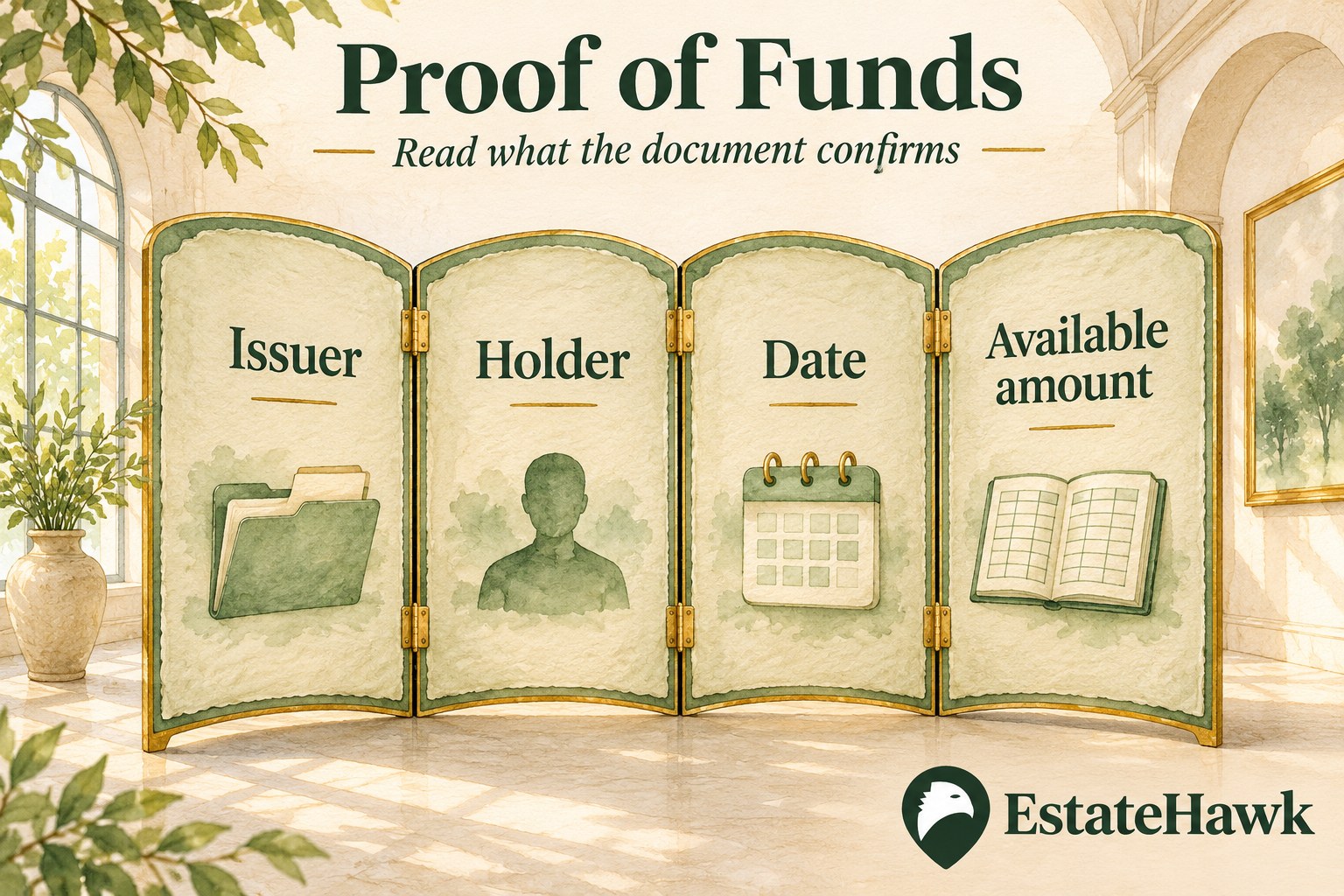
To satisfy a seller, escrow officer, or auction registrar, your proof of funds must answer four fundamental questions with verified legal precision:
Question number one: Whose money is it?
This is where amateur investors constantly stumble.
An investor establishes an LLC named Oakridge Investments LLC. The investor submits a purchase offer signed by Oakridge Investments LLC.
Then, for proof of funds, the investor attaches a personal checking account statement in the name of John Smith.
The listing agent and seller's attorney will reject that offer immediately.
Why? Because John Smith and Oakridge Investments LLC are two entirely separate legal entities.
Under real estate contract law, a seller has zero legal right to seize John Smith's personal bank account if Oakridge Investments LLC breaches the contract. Unless the submission includes a formal, corporate banking resolution and an operating agreement demonstrating that John Smith is the sole managing member authorized to commit those funds to the LLC's real estate transactions, a personal statement does not prove corporate liquidity.
The name on the bank statement must match the buyer named on the contract, character for character.
Question number two: How much of the money is genuinely liquid?
Amateur investors routinely submit documentation showing four hundred thousand dollars in financial assets.
Then the escrow officer reads the statement and discovers that three hundred thousand dollars of that balance is locked inside an illiquid 401(k) retirement plan, a restricted stock option vesting pool, or an unactivated commercial line of credit.
A 401(k) balance is not liquid cash. Liquidating retirement funds requires formal withdrawal requests, mandatory federal tax withholding, early withdrawal penalties, and multi-week processing delays. An unactivated home equity line of credit is an unborrowed debt facility, not cash in a bank account.
Proof of funds must demonstrate cash or cash equivalents sitting in checking accounts, savings accounts, certificates of deposit, or liquid money market funds that can be wired to escrow upon twenty-four hours' notice.
Question number three: When was the balance verified?
Money is dynamic. A bank statement showing two hundred thousand dollars on June 15 tells you absolutely zero about what is in that account on October 20.
The buyer might have purchased inventory, paid tax liabilities, or wired the money into another investment.
Most institutional sellers, banks marketing REO properties, and sophisticated private sellers require proof of funds documentation dated within the preceding thirty days. Submitting a quarterly statement that is four months old is a guaranteed way to have your offer discarded as unverified.
Question number four: Can the funds actually be used for this specific purchase?
If the documented account is a joint account, a partnership account, or an escrow trust account, the funds may carry strict legal restrictions. If an account requires dual signatures, or if the funds represent a trust balance held for third-party clients, using those funds to purchase speculative real estate without explicit fiduciary authorization constitutes unlawful commingling of trust funds.

Now let us examine the catastrophic financial trap that snags careless cash buyers: the closing cost shortfall.
Amateur investors believe that if a house is priced at $250,000, having $250,000 in a bank account means they are fully funded.
That is an absolute mathematical delusion.
Purchase price is not cash to close.
When you purchase real estate, the purchase price represents only the consideration paid to the seller for the physical dirt and improvements.
It completely ignores the mandatory transactional expenses of the closing table:
You have title search and title examination fees.
You have the owner's policy of title insurance.
You have escrow and settlement closing fees charged by the closing agency.
You have county and state documentary transfer taxes, which in states like Pennsylvania or Washington can easily exceed two to three percent of the purchase price.
You have recording fees for the deed and municipal tax certifications.
You have prorated county property taxes, municipal sewer assessments, and pre-funded HOA dues.
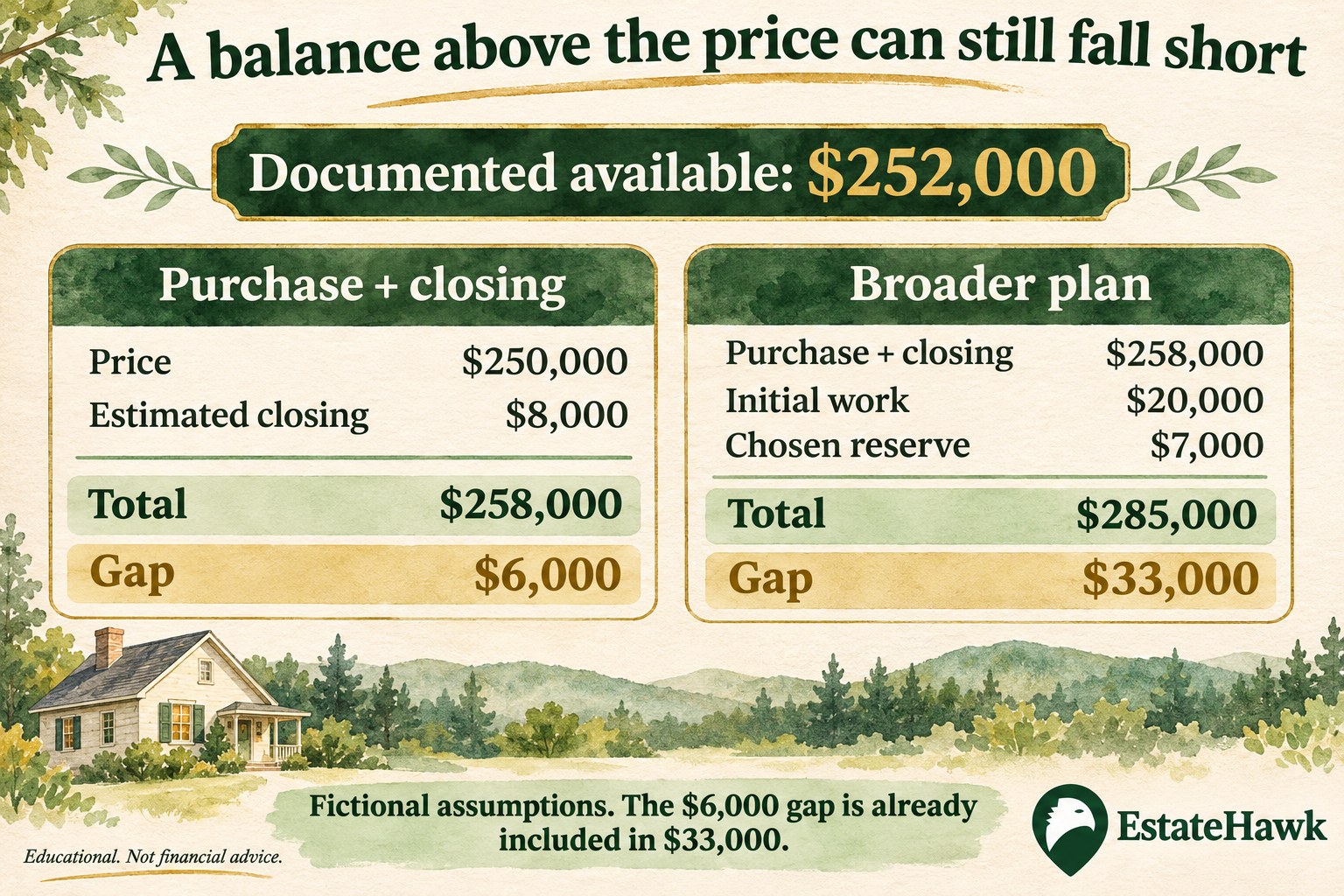
In our realistic $250,000 transaction, closing costs easily total $8,000.
Now look at the arithmetic:
Purchase price: $250,000.
Closing expenses: $8,000.
Actual cash required at the closing table: $258,000.
If your proof of funds letter shows an account balance of $252,000, you are not well-funded. You have an immediate six-thousand-dollar cash shortfall. You cannot close the deal.
Furthermore, look at the broader operational plan.
If the property needs $20,000 in immediate stabilization repairs before it can be occupied, and you must maintain a $7,000 liquid operating reserve to protect against unexpected mechanical emergencies, your true project cash requirement is $285,000.
Against your documented balance of $252,000, you are facing a thirty-three-thousand-dollar capital gap.
If you submit an offer based on bare purchase price while ignoring closing costs and repair capital, you are setting yourself up for an embarrassing closing-table default.
Now consider underwriting standards and document redaction.
When you are purchasing real estate with mortgage financing, proof of funds takes on an even more rigid legal character.
Under Fannie Mae Selling Guide Section B3-4.2 and Form 1006 Verification of Deposit standards, mortgage underwriters require two consecutive months of full, unaltered bank statements.
Notice the word full.
If your bank statement says "Page 1 of 6" at the bottom of the page, you must submit all six pages.
Amateur borrowers routinely submit only page one and page two because pages three through six contain routine grocery store charges or are blank pages.
The moment a mortgage underwriter sees "Page 1 of 6" and receives only two pages, the entire file is rejected for missing documentation. Underwriters are legally required under federal anti-money laundering and Bank Secrecy Act rules to examine all pages to detect undisclosed debts, large unverified cash deposits, and recent borrowed funds.
Now look at redaction.
It is entirely appropriate to protect your sensitive financial privacy when submitting proof of funds to a private seller or real estate agent.
You can safely redact your full social security number, your home address, and the first six to eight digits of your bank account number, leaving only the final four digits visible for verification.
However, you must never alter dates, alter account holder names, or alter balance figures.
In the digital era, amateur investors think they can open a PDF editor, change an account balance from $12,000 to $120,000, and submit it as proof of funds.
That is not a harmless real estate shortcut.
Altering a financial institution statement to induce a seller or lender to enter into a real estate contract constitutes federal bank fraud, wire fraud, and criminal forgery under 18 U.S.C. Section 1344. Federal prosecutors regularly indict individuals who submit falsified bank statements in real estate transactions, carrying severe criminal penalties and federal prison sentences.
If you do not have the cash, do not fake the document. Obtain genuine private lending, partner with an equity investor, or submit a properly disclosed financed offer.
Now consider the nightmare of real estate wire fraud and fake requests.
This is where buyers lose hundreds of thousands of dollars in a single afternoon.
The National Association of Realtors and the District of Columbia Department of Insurance, Securities and Banking publish urgent consumer alerts regarding real estate wire fraud.
Cybercriminals actively hack into the unencrypted email accounts of real estate agents, title officers, and buyers.
The hacker monitors the transaction silently for weeks. Two days before closing, the hacker sends an email spoofing the title company's email address, complete with corporate logos and legitimate-looking signature blocks, stating: "Our wiring instructions have been updated for safety. Please wire your $250,000 closing funds to our updated account at First National Bank."
The unsuspecting buyer wires the money.
Within ten minutes, the criminal syndicates transfer the funds into overseas offshore accounts or convert it into cryptocurrency. The money is gone forever. The title company never receives the funds, and the buyer loses their entire life savings.
To protect yourself against wire fraud, you must follow one non-negotiable rule: never wire money based on an email.
Always call the verified, independently obtained telephone number of your title company or closing attorney, speak directly to the licensed closing officer handling your file, and verbally confirm every single digit of the routing number, account number, and recipient beneficiary name before initiating any wire transfer.
Let us walk through an educational case study that demonstrates how an improper proof of funds submission destroyed an acquisition.
Consider an investor named Trevor who is pursuing an off-market distressed property on Fairview Road. The seller is a motivated estate executor who wants a fast, thirty-day all-cash closing.
Trevor submits a cash purchase offer for $215,000.
To satisfy the proof of funds requirement, Trevor visits an online real estate forum and finds a company offering a "Proof of Funds Pre-Approval Letter" for fifty dollars. The company issues Trevor a flashy, embossed PDF on corporate letterhead stating that Trevor has an approved "Line of Credit of $250,000 available for real estate acquisitions."
Trevor attaches this letter to his purchase contract.
The estate executor delivers the offer to the probate attorney handling the estate.
The probate attorney looks at the letterhead. The letterhead lists a company named "National Liquidity Capital Group" with a 1-800 phone number and an address in another state.
The attorney performs a quick corporate registry search. The company is not registered to do business in the state, is not an FDIC-insured depository bank, and holds zero state lending licenses.
The attorney calls the 1-800 number printed on the letterhead. An automated voicemail answers, asking callers to leave a message.
The attorney immediately advises the estate executor to reject Trevor's offer. The attorney notes that Trevor submitted an unverified letter from an unlicensed entity, demonstrating zero proof of actual liquid cash.
The executor rejects Trevor's contract and accepts a competing cash offer for $210,000 from another investor who provided a clean, verified two-page bank balance confirmation letter directly from a local credit union.
Trevor lost a profitable deal that had forty thousand dollars in equity spread because he relied on a cheap internet proof of funds template instead of providing legitimate depository verification.
Now let us examine the four conversational questions that constantly arise whenever property buyers prepare proof of funds.
The first question involves technology: Is a smartphone banking app screenshot acceptable as official proof of funds?
Rarely. While an informal private seller might glance at a smartphone screenshot, sophisticated sellers, commercial brokers, institutional asset managers, and title attorneys will reject it. Mobile app screenshots are notoriously easy to manipulate with digital photo editing tools and frequently omit critical verification data, such as the full legal name of the account holder, the bank's official routing number, and the specific statement period. The gold standard of proof of funds is an official, institution-issued monthly account statement or a formal Verification of Deposit letter printed on official bank letterhead, signed by an authorized branch officer, displaying the account holder's name and verified liquid balance.
The second question concerns closing costs: Does having an account balance equal to the purchase price guarantee that you have enough funds to complete the purchase?
Never assume that. As we analyzed earlier, the purchase price represents only the gross payment to the seller. Completing a real estate transaction requires paying significant mandatory closing costs, including title search fees, owner's title insurance policies, settlement fees, transfer taxes, recording charges, and property tax prorations, which routinely add two to four percent to the total cash requirement. If your bank balance exactly matches the purchase price, you will face an immediate cash shortfall at the escrow table. Your proof of funds must cover the purchase price plus all estimated closing and settlement expenses.
The third question involves financing: Can a mortgage pre-approval letter be used as proof of funds in an all-cash purchase transaction?
No. A mortgage pre-approval letter is an expression of potential financing, not cash. Submitting a pre-approval letter on a contract marked "All Cash" creates a material contractual contradiction. In an all-cash purchase, the buyer waives all financing contingencies and promises to deliver liquid funds without relying on a third-party mortgage lender. An all-cash offer requires verified cash in a bank account, not a conditional pre-approval letter from a loan officer.
The fourth question addresses technology: Where do modern property intelligence platforms and digital verification tools fit into proof of funds analysis?
Online real estate software platforms and automated research tools are outstanding for market research, parcel boundary analysis, and tax assessment retrieval. However, public property platforms cannot verify private bank account balances or confirm an individual's financial liquidity. Software data must always be paired with authenticated banking documentation, certified depository letters, and professional escrow verification before executing binding real estate agreements.
When you prepare proof of funds for a real estate acquisition, approach the documentation with absolute professional rigor.
Ensure that the legal name on the bank statement matches the contract buyer character for character. Confirm that the funds are liquid and readily available. Calculate your total cash requirement to include closing expenses, initial repairs, and operating reserves, and verify all wire instructions through trusted, independent phone channels.
Operating with that level of financial discipline is what protects your capital, preserves your professional reputation, and ensures that your purchase offers are taken seriously by sellers and closing attorneys alike.