
Notice of Trustee Sale: What to Verify Before Bidding
A recorded notice starts a review. Match the underlying instrument, verify the current sale instructions and resolve unanswered title questions before bidding.
 By EstateHawk
On this page

Let's talk about the act of standing on the courthouse steps with an envelope full of cashier's checks. If you listen to aggressive foreclosure auction flippers on the internet, your first tip for buying distressed real estate is almost always to find a Notice of Trustee Sale and show up ready to outbid the crowd.
Who would have thought?
Find a legal notice posted on a county bulletin board, withdraw fifty thousand dollars in certified bank checks, stand by a granite courthouse pillar at ten in the morning, and wave your hand in the air to buy a suburban home for forty cents on the dollar. Truly breathtaking investment wisdom. So elegant in its simplicity. So exquisitely horrifying when you discover three weeks later that the instrument being foreclosed was an obscure second-position home equity line of credit for thirty-five thousand dollars, leaving you owning a house subject to an unreleased, fully active first mortgage of two hundred and eighty thousand dollars held by Wells Fargo.
While we're distributing miracle advice, let's make sure high-altitude skydiving instructors remember to pack their parachutes with dirty laundry and bowling balls. Let's make sure deep-sea saturation divers remember to replace their oxygen tanks with carbonated lemonade.
No, "just show up and bid on the trustee sale" is advice manufactured for fake property auctioneers. It belongs to the guru crowd who believe that non-judicial foreclosure auctions operate like an automated clearance sale where every senior debt magically vanishes into thin air the moment the auctioneer's gavel makes contact with the podium. Those people think a county document with the word "foreclosure" stamped across the top is a government-issued certificate of clear title.
Here's what the auction seminar barkers and superficial advice blogs will never explain: for an authentic foreclosure title abstractor or seasoned distressed debt underwriter, dissecting a Notice of Trustee Sale isn't a casual scan, it's an obsession they have zero control over.
If you let an authentic title obsessive anywhere near a recorded foreclosure notice, their brain completely disconnects from all standard conversational pleasantries. Normal people look at the notice and notice the appealing street address and the low opening bid. The document obsessive could not care less about the address. They want to know the exact recording date, book, and page number of the underlying deed of trust being foreclosed, whether the substitute trustee was formally appointed through a recorded Substitution of Trustee under California Civil Code Section 2934a or Texas Property Code Section 51.002, whether the borrower filed a last-minute Chapter 13 bankruptcy petition that triggered an automatic stay under 11 U.S.C. Section 362, and whether California Civil Code Section 2924m post-sale tenant redemption rights apply to the parcel.
In fact, if you leave that researcher unsupervised at two in the morning with an open browser, they won't even be reviewing trustee sale dockets at all. They will have fallen headfirst into an algorithmic rabbit hole on a Polish military vehicle collectors exchange, studying auction listings for a decommissioned Soviet AT-P armored artillery tractor. They will spend two solid hours examining technical blueprints of its 110-horsepower ZIS-123 six-cylinder gasoline engine and torsion-bar suspension, analyzing how its lightweight welded armored hull allowed it to tow an eighty-five-millimeter anti-tank gun through waist-deep spring mud at thirty miles an hour, calculating whether its narrow steel tracks would throw a pin while traversing a rocky river crossing in the Carpathian Mountains, and reading translated forum flame wars from 2011 about whether carburetor vapor lock occurs during extreme high-altitude mountain operations.
Then the Instant Gratification Monkey at the back of their brain gets hit with a cold shock of pure dread. The Rational Decision-Maker kicks down the door, drags them away from Soviet tracked artillery tractors, and slams their face back into the county recorder database. Because right there on the digitized grantor-grantee index is an unreleased senior purchase-money mortgage from 2016, and someone in the acquisitions department is about to blow sixty thousand dollars on a junior lien auction tomorrow morning.
Welcome to the unforgiving, strictly governed legal battlefield of the Notice of Trustee Sale.
The primary error that destroys amateur foreclosure bidders begins with a complete failure to understand what a Notice of Trustee Sale actually represents.
A Notice of Trustee Sale, universally abbreviated as an NOTS, is not a property deed.
It does not transfer title. It does not certify that the property is vacant. It does not promise that the auction will take place as scheduled. And it certainly does not guarantee that the winning bidder will receive clear, unencumbered ownership of the real estate.
A Notice of Trustee Sale is a formal statutory announcement that a foreclosure trustee, operating under the contractual power of sale clause contained in a recorded deed of trust, intends to sell a specific encumbered interest in real property at a public auction to satisfy an outstanding financial default.
This immediately separates non-judicial trustee sales from judicial sheriff sales.
In judicial foreclosure states like Florida, New York, or Ohio, a foreclosure requires a formal civil lawsuit, a judicial decree of foreclosure signed by a judge, and an auction conducted by the county sheriff.
In non-judicial foreclosure states like California, Texas, Washington, Arizona, Nevada, and Georgia, foreclosures run entirely outside the judicial branch. They are executed by private foreclosure trustees, such as title companies, attorneys, or institutional trustee services, strictly adhering to statutory calendars and notice requirements set by state real estate codes.
In Texas, for example, under Texas Property Code Section 51.002, a Notice of Substitute Trustee Sale must be filed with the county clerk, posted at the county courthouse door, and mailed by certified mail to the borrower at least twenty-one days before the sale date, which by law occurs on the first Tuesday of the month between ten in the morning and four in the afternoon.
In Arizona, under Arizona Revised Statutes Section 33-808, a trustee sale cannot take place until at least ninety days after the recording of the Notice of Trustee's Sale in the county recorder's office.
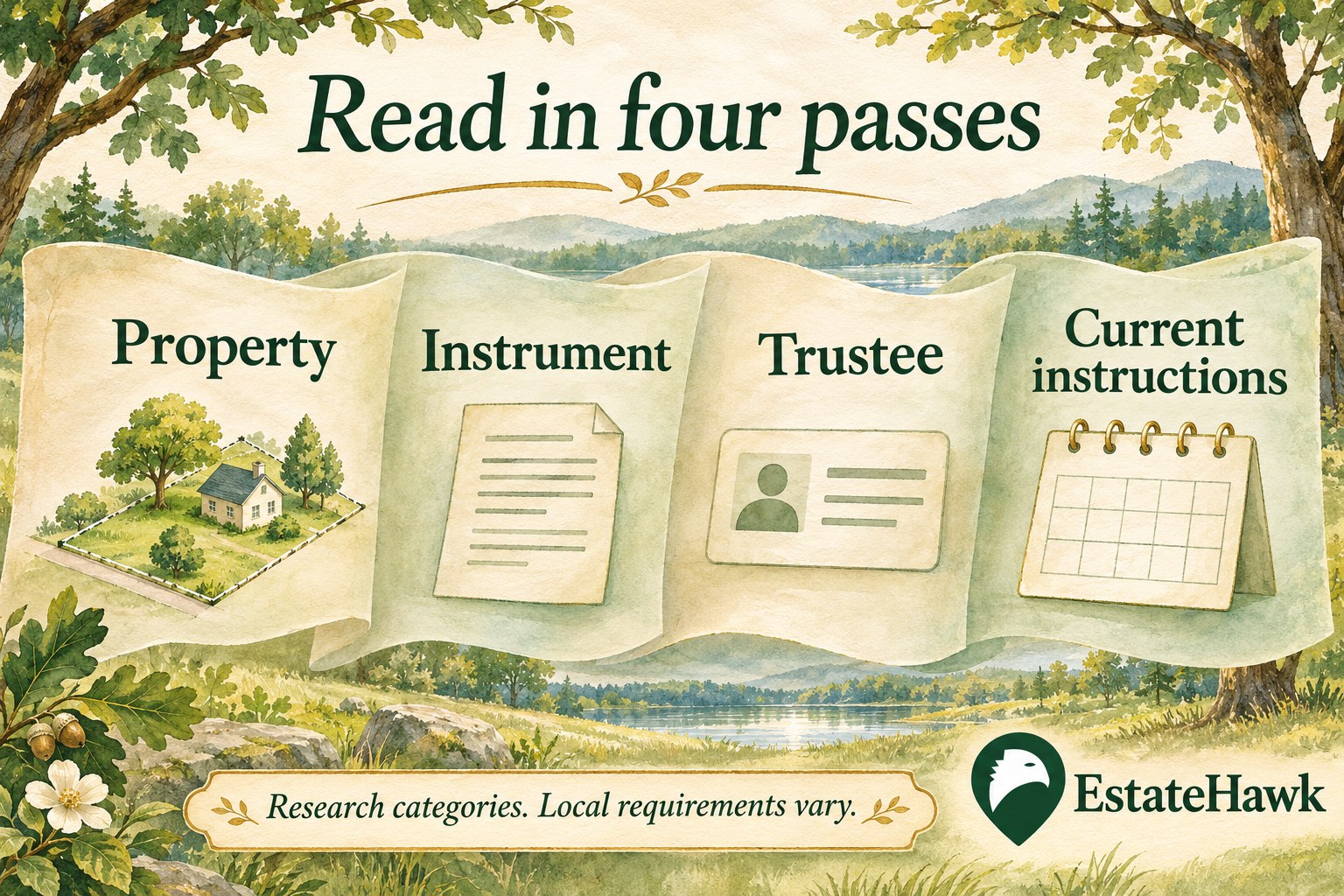
To evaluate an NOTS without risking total financial ruin, you must conduct a disciplined, four-pass forensic audit of the physical document and its underlying chain of title:
Pass number one is the property description.
Never rely solely on the physical street address printed on the notice.
In almost every non-judicial foreclosure statute in America, the legal description of the real property governs the sale, not the street address. The notice will explicitly state: "The street address and other common designation, if any, is shown for informational purposes only, and no warranty is made as to its correctness."
If the street address says 412 Maple Street, but the legal description attached to the notice describes only Lot 14 of Tract 8912, representing the vacant half-acre side yard, while the actual physical house sits on Lot 15, you are bidding on dirt, not a house.
You must pull the recorded subdivision plat map, verify the parcel boundary, and cross-reference the Assessor's Parcel Number against the certified deed description.
Pass number two is the underlying security instrument.
This is the single most critical, life-or-death pass in the entire foreclosure evaluation process: identifying the exact instrument being foreclosed.
A Notice of Trustee Sale does not foreclose an entire property. It forecloses a specific recorded document.
The notice will state: "Default has occurred under that certain Deed of Trust executed by John Doe as Trustor, recorded on April 12, 2018, as Instrument Number 2018-048912, in Book 1420, Page 88, official records of the County Recorder."
You must pull that exact recorded document from the county land records.
Why? Because you must determine the lien priority of that specific deed of trust.
This brings us to the ultimate catastrophic trap of foreclosure auctions: senior versus junior lien priority.
Under foundational American property law, the recording date and the legal nature of an encumbrance establish its priority. First in time is first in right.
When a first-position purchase-money mortgage forecloses at a trustee sale, the sale legally wipes out that first mortgage and extinguishes all junior liens recorded after it, including second mortgages, home equity lines of credit, junior mechanics liens, and unsecured judgment liens.
However, reverse that scenario.
What happens when an owner took out a primary mortgage for $250,000 in 2015, and then took out a second home equity line of credit for $40,000 in 2019?
The borrower continues paying the first mortgage faithfully, but stops paying the second equity line.
The lender on the second equity line instructs the trustee to record a Notice of Default and a Notice of Trustee Sale.
The auctioneer stands on the courthouse steps and opens the bidding at forty thousand dollars.
An amateur investor sees the house, knows it is worth $350,000, and bids forty-five thousand dollars. The auctioneer's gavel falls.
The amateur investor hands over forty-five thousand dollars in certified cashier's checks, receives a Trustee's Deed Upon Sale, and celebrates a massive triumph.
Then reality strikes.
The trustee sale was foreclosing the junior second deed of trust.
A junior foreclosure sale does NOT extinguish senior liens.
Senior liens survive the auction completely untouched.
The winning bidder acquires the property subject to the senior first mortgage.
Wells Fargo still holds a recorded $250,000 first mortgage on the property. Wells Fargo's lien remains attached to the dirt.
If the new buyer does not immediately pay off the $250,000 senior mortgage or assume its payments, Wells Fargo will initiate its own foreclosure, wipe out the amateur investor's interest, and take the house.
The investor did not buy a house for forty-five thousand dollars. They bought the borrower's equity of redemption for forty-five thousand dollars, encumbered by a quarter-million-dollar mortgage.
Pass number three is the administrator and trustee authority.
You must verify that the party conducting the sale actually possesses the legal authority to execute the foreclosure.
Inspect the administrator line. The notice will identify the named trustee or substitute trustee.
If the original deed of trust named First American Title as trustee in 2012, but the Notice of Trustee Sale is being executed by Western Progressive LLC or Quality Loan Service Corporation as substitute trustee, you must search the county land records to ensure that a formal, validly executed Substitution of Trustee was recorded prior to the sale.
Under California Civil Code Section 2934a, executing a foreclosure sale without a properly recorded substitution of trustee creates a fatal cloud on title that can render the resulting Trustee's Deed Upon Sale void or voidable in a subsequent wrongful foreclosure lawsuit.
Pass number four is the current sale instructions and status.
Never trust a printed auction date on a document downloaded two weeks ago.
Foreclosure auctions are notoriously volatile legal proceedings. A sale scheduled for Thursday morning at ten o'clock can change twelve times before the gavel falls.
Sales are routinely postponed for three primary reasons:
First, a federal bankruptcy filing. If the borrower files a Chapter 7 or Chapter 13 bankruptcy petition at nine-thirty on the morning of the auction, federal law under 11 U.S.C. Section 362 imposes an immediate, automatic stay. The automatic stay legally halts all collection and foreclosure actions instantly nationwide. If a trustee conducts an auction after an automatic stay is triggered, the sale is legally void ab initio, a complete nullity under federal law.
Second, loan loss mitigation. Under federal Consumer Financial Protection Bureau regulations (Regulation X, 12 CFR Section 1024.41), mortgage servicers are strictly prohibited from dual-tracking, which means they cannot proceed with a foreclosure sale while a complete loss mitigation application is actively being evaluated.
Third, administrative and mutual postponements. The borrower and lender might agree to a temporary thirty-day postponement to allow for a loan modification, a short sale review, or private refinancing.
In non-judicial foreclosure states, postponements do not require re-recording a new notice. The trustee simply sends a representative to the courthouse steps to verbally announce: "Trustee Sale Number 8912 is hereby postponed to November 14 at ten in the morning."
To know whether a sale is active, you must call the trustee's automated telephone tracking hotline or check their official web portal using the exact trustee sale reference number on the afternoon prior to the auction and again thirty minutes before the scheduled time.
Now consider post-sale finality and the revolution of California Senate Bill 1079.
This is where investors who buy foreclosure auctions in California get completely blindsided.
Historically, when the auctioneer's gavel fell on the courthouse steps and the winning bidder handed over their cashier's checks, the sale was legally final. The trustee executed a Trustee's Deed Upon Sale, and the buyer took immediate equitable and legal ownership.
In California, that rule was completely rewritten by Senate Bill 1079, codified under California Civil Code Section 2924m.
Under Civil Code Section 2924m, if the property being sold at a trustee auction contains one to four residential units, the sale is NOT final on auction day if the winning bidder is a private investor.
The statute creates a post-sale redemption and upset-bid window for specific protected classes: eligible tenant buyers and eligible non-profit housing entities.
Here is how the statutory mechanics work:
If an eligible tenant who was leasing the property at the time of the sale submits a formal notice of intent to bid within fifteen days, and delivers a matching cashier's check equal to the winning investor's bid within forty-five days, the tenant legally snatches the property away from the investor at the investor's winning bid price.
Furthermore, an eligible community non-profit organization or affordable housing corporation has forty-five days to submit an upset bid that exceeds the investor's winning bid by just a single penny.
The private investor's money is tied up in escrow for forty-five days, completely unearning interest, and at the end of the forty-five-day window, the non-profit can take the house, leaving the investor with zero property and a bureaucratic refund delay.
A trustee sale is not a closed deal until every statutory finality window has formally expired.
Let us walk through an educational case study that demonstrates how an unverified Notice of Trustee Sale destroys an investor's balance sheet.
Consider an investor named Nathan who actively scans foreclosure notices in a growing suburban market.
Nathan spots a Notice of Trustee Sale for an attractive four-bedroom, three-bathroom home on Sycamore Boulevard. The notice shows an opening bid of just $48,000. Nathan checks an online valuation platform and sees that the property has an estimated market value of $340,000.
Nathan does not pull the chain of title. Nathan does not order an automated title search or consult a title abstractor. He reads the street address, sees the $48,000 opening bid, and tells himself: "I have found the deal of a lifetime!"
On Tuesday morning, Nathan stands on the courthouse steps. The substitute trustee announces the sale for the Sycamore Boulevard parcel.
Nathan enters the bidding war against another amateur. The auctioneer's gavel falls on Nathan's winning bid of $62,000.
Nathan delivers $62,000 in certified cashier's checks, receives his certificate of sale, and waits for his Trustee's Deed Upon Sale.
Nathan drives over to the property, walks up to the front door, and tells the resident that he is the new owner and that they have thirty days to vacate.
Two weeks later, Nathan receives a certified letter from the legal department of Bank of America.
The letter informs Nathan that Bank of America holds a first-position deed of trust against the Sycamore Boulevard property, recorded in October 2014 under Instrument Number 2014-089124, securing an unpaid principal balance of $218,000.
Furthermore, the mortgage is in default, with $28,000 in delinquent interest, escrow advances, and legal fees. Total payoff balance required: $246,000.
Nathan is completely horrified. "I bought this house at a trustee auction! The auction wipes out all mortgages!" Nathan screams into the phone.
Nathan hires a seasoned real estate litigation attorney.
The attorney pulls the recorded land records and delivers the devastating legal truth.
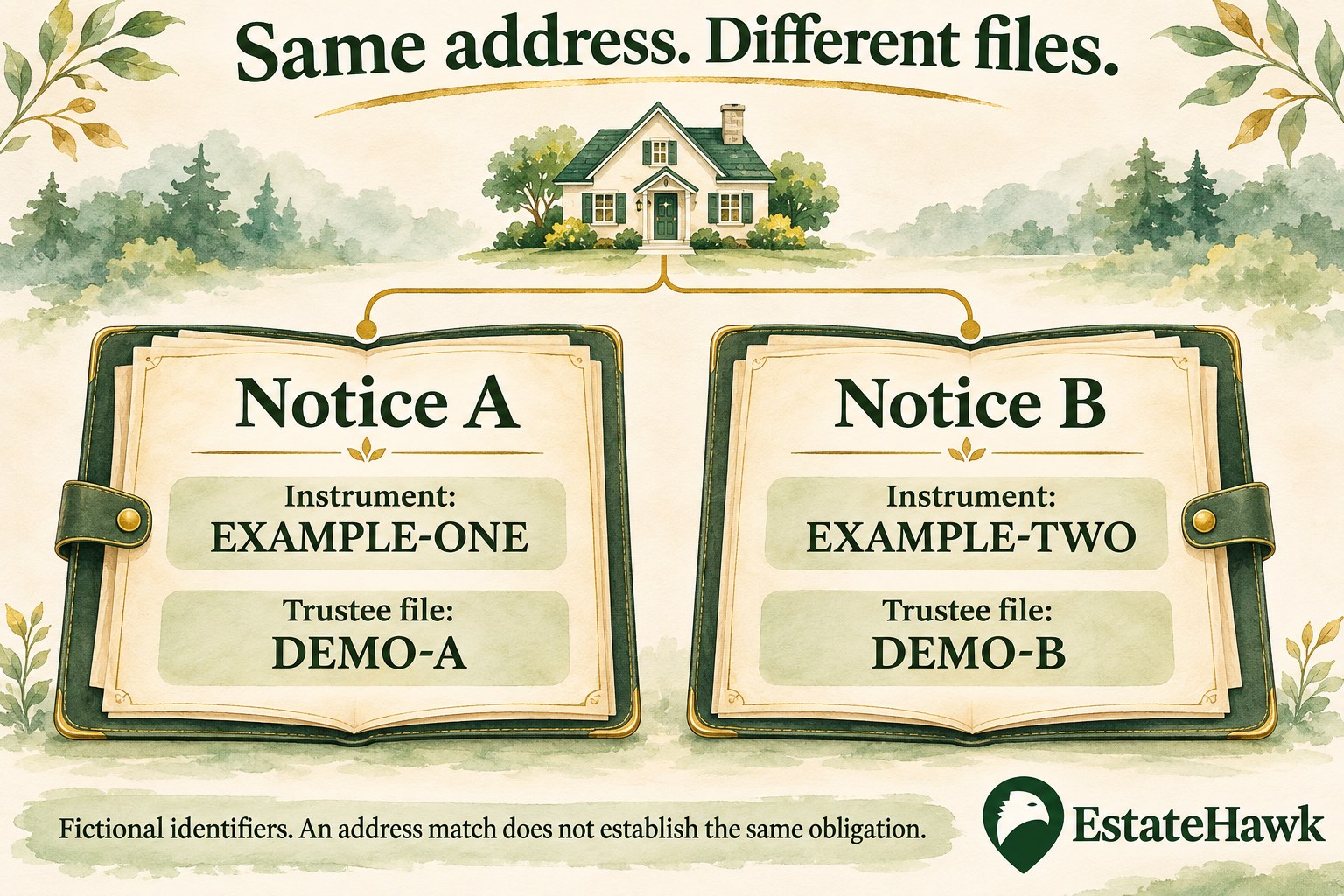
The Notice of Trustee Sale Nathan bid on was foreclosing a second deed of trust.
In 2018, the previous owner took out an equity line of credit for $45,000 with a local regional credit union. That credit union recorded a second deed of trust, which was junior to Bank of America's 2014 mortgage.
The borrower stopped paying the second equity line. The credit union foreclosed.
Because the credit union held a junior encumbrance, the trustee sale only conveyed the property subject to Bank of America's senior first mortgage.
Bank of America's $246,000 lien was completely untouched by the auction.
Worse yet, Bank of America had already recorded its own Notice of Default two months earlier and scheduled its senior foreclosure auction for next month.
Nathan has zero options.
To avoid losing the property entirely, Nathan would have to pay Bank of America $246,000 in cash to satisfy the senior mortgage, on top of the $62,000 he had already handed to the substitute trustee on the courthouse steps, for a house that was only worth $340,000 to begin with.
Nathan did not make a fortune. Nathan lost sixty-two thousand dollars because he failed to trace the underlying instrument to determine lien priority before bidding.
Now let us examine the four conversational questions that arise whenever property investors evaluate a Notice of Trustee Sale.
The first question involves encumbrances: Does winning a trustee auction automatically guarantee that all prior liens, mortgages, and debts are wiped out?
Absolutely not. A trustee sale only extinguishes the specific deed of trust being foreclosed and all junior encumbrances recorded chronologically after it. Any senior mortgage, senior deed of trust, or superior lien recorded prior to the foreclosing instrument survives the auction completely intact. Furthermore, municipal ad valorem property taxes, municipal special assessments, and federal tax liens with statutory IRS redemption rights under 26 U.S.C. Section 7425 survive the sale. You must conduct a complete title search to verify lien priority before placing a bid.
The second question concerns ownership: Does having the highest bid on the courthouse steps mean you immediately own the property and can take possession?
Never assume that the gavel fall grants immediate ownership or possession rights. In many jurisdictions, such as California under Civil Code Section 2924m, sales of residential properties are subject to statutory post-sale redemption and upset-bid windows for eligible tenants and non-profit housing entities. Furthermore, even after the Trustee's Deed Upon Sale is recorded, you have zero legal right to engage in self-help eviction. If the previous owner or a tenant remains in the home, you cannot change locks, shut off utilities, or remove belongings. You must execute a formal statutory eviction proceeding under state unlawful detainer laws.
The third question involves legal stays: What happens if the homeowner files for bankruptcy on the morning of the trustee sale?
If the property owner files for federal bankruptcy protection prior to the moment the auction gavel falls, an automatic stay is triggered immediately under 11 U.S.C. Section 362. The automatic stay renders any subsequent foreclosure sale legally void ab initio, a complete nullity under federal law, regardless of whether the trustee was personally aware of the filing. If you bid and pay for a property subject to an active bankruptcy stay, the sale will be vacated, and your funds will be tied up in bureaucratic refund processing.
The fourth question addresses technology: Where do modern property intelligence platforms and automated auction software fit into trustee sale research?
Online real estate software platforms and foreclosure databases are outstanding for preliminary lead discovery, tracking upcoming county dockets, and pulling historical recording references. However, digital software tools cannot verify live courthouse-step postponements, interpret ambiguous legal descriptions, or provide a certified legal guarantee of title priority. Software research must always be validated by pulling official county land records, reviewing the specific recorded deed of trust, and consulting with a qualified real estate title professional or attorney before committing capital.
When you prepare to bid on a Notice of Trustee Sale, approach every file with absolute forensic discipline.
Never assume that a low opening bid represents a bargain. Verify the legal description against certified plat maps. Trace the recorded deed of trust to confirm beyond any doubt that it occupies a first-position lien priority. Verify live auction status thirty minutes before the sale, and account for all post-sale statutory redemption rights.
Operating with that level of legal and transactional rigor is what protects your capital, preserves your equity, and ensures that your foreclosure acquisitions represent genuine real estate wealth rather than catastrophic legal liabilities.