
Cap Rate: Calculate It and Test the Income Assumptions
The formula is simple; the inputs need work. Trace the income and expenses, label the price basis and test how a different assumption changes the ratio.
 By EstateHawk
On this page
Let's talk about the act of ranking commercial real estate on a napkin. If you spend five minutes listening to apartment syndicators on podcast interviews, your first tip for evaluating a commercial multi-family building is almost always to find a property with an eight percent capitalization rate and jump on it immediately.
Who would have thought?
Take the broker's advertised net operating income, divide it by the asking price, and if the percentage hits your favorite target number, call your private investors and start planning your retirement party. Truly dizzying heights of investment intellect. So elegant in its simplicity. So breathtakingly suicidal when you discover three months into ownership that the broker's advertised net operating income was calculated using the seller's grandfathered 1994 property tax assessment, modeled zero percent tenant vacancy, and completely omitted professional property management fees, turning your eight percent golden goose into a five percent cash trap.
While we're handing out revolutionary wisdom, let's make sure high-altitude mountain climbers remember to leave their heavy parkas at base camp to save luggage weight. Let's make sure Formula One drivers remember to navigate sharp hairpin turns by closing their eyes and pressing the accelerator to the floor.
No, "just buy the highest cap rate" is advice manufactured for fake commercial investors. It belongs to the spreadsheet dabblers who believe that a capitalization rate is an objective, universal score like a golf handicap that tells you everything you need to know about a property without ever looking at a utility bill, an aging flat roof, or a municipal tax reassessment docket. Those people think a cap rate is an ironclad legal promise of annual cash return.
Here's what the commercial brokerage listing brochures and superficial financial courses will never explain: for an authentic commercial acquisitions analyst, certified appraiser, or institutional portfolio manager, stress-testing a capitalization rate isn't a casual division, it's an obsession they have zero control over.
If you let an authentic valuation obsessive anywhere near an offering memorandum, their brain completely disconnects from all standard conversational pleasantries. Normal investors look at the glossy brochure and admire the swimming pool and the fitness center. The document obsessive could not care less about the fitness center. They want to know whether the Net Operating Income was derived from trailing twelve-month historical operating statements or speculative pro forma market projections, whether the vacancy allowance reflects local submarket absorption trends under Freddie Mac capitalization rate standards, whether the municipal property tax assessor conducts an automatic sale-price reassessment that will trigger a forty percent property tax spike, and whether California Board of Equalization direct capitalization methodologies were applied correctly to isolate property-level productivity from debt service.
In fact, if you leave that researcher unsupervised at two in the morning with an open browser, they won't even be reviewing rent rolls at all. They will have fallen headfirst into an algorithmic rabbit hole on a Russian heavy military engineering forum, studying auction listings for a decommissioned Soviet IMR-2 combat engineering clearing vehicle. They will spend two solid hours examining technical blueprints of its 840-horsepower multi-fuel V-12 diesel engine and its massive telescoping hydraulic boom, analyzing how its heavily armored tank hull allowed it to bulldoze a path through flattened pine forests and radioactive urban rubble with a multi-purpose dozer blade, calculating whether its heavy steel tracks would crush an asphalt suburban parking lot into gravel, and reading translated forum flame wars from 2011 about whether hydraulic fluid cavitation destroys its robotic manipulator valves in negative forty-degree Siberian winters.
Then the Instant Gratification Monkey at the back of their brain gets hit with a cold shock of pure dread. The Rational Decision-Maker kicks down the door, drags them away from Soviet heavy armored combat bulldozers, and slams their face back into the commercial income ledger. Because right there on the broker's pro forma is an unaddressed nine-thousand-dollar property tax reassessment that is about to drop the calculated cap rate from 8.2 percent straight down to 6.1 percent.
Welcome to the unforgiving, strictly defined mathematical universe of the Capitalization Rate.
The foundational trap that destroys novice commercial real estate investors begins with a complete failure to understand what a capitalization rate actually measures.
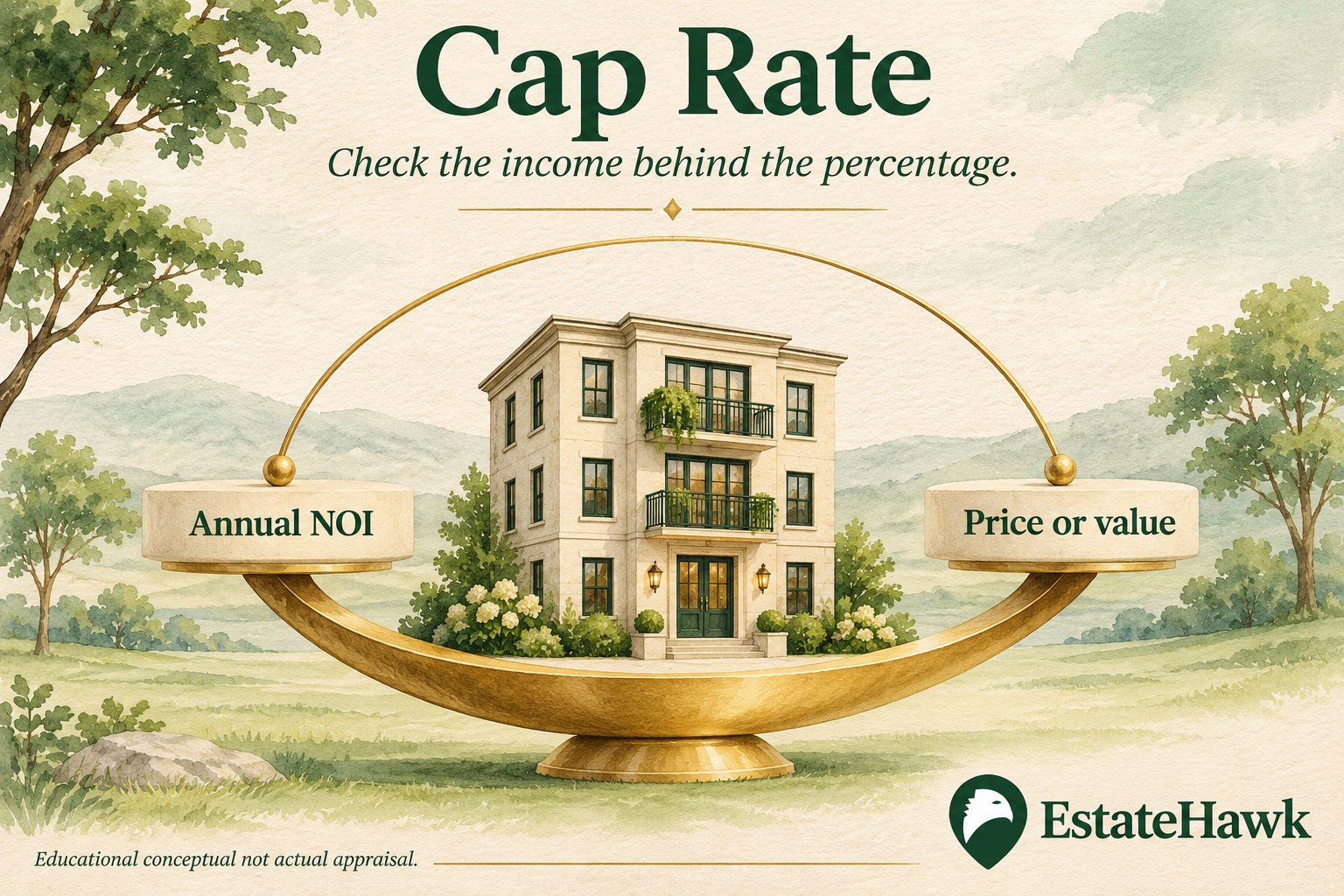
A capitalization rate, universally abbreviated as Cap Rate, is an unleveraged operational metric.
It measures the fundamental economic productivity of the physical real estate asset itself, over a single twelve-month operational period, completely independent of mortgage financing, loan terms, and income taxes.
The mathematical formula requires basic arithmetic:
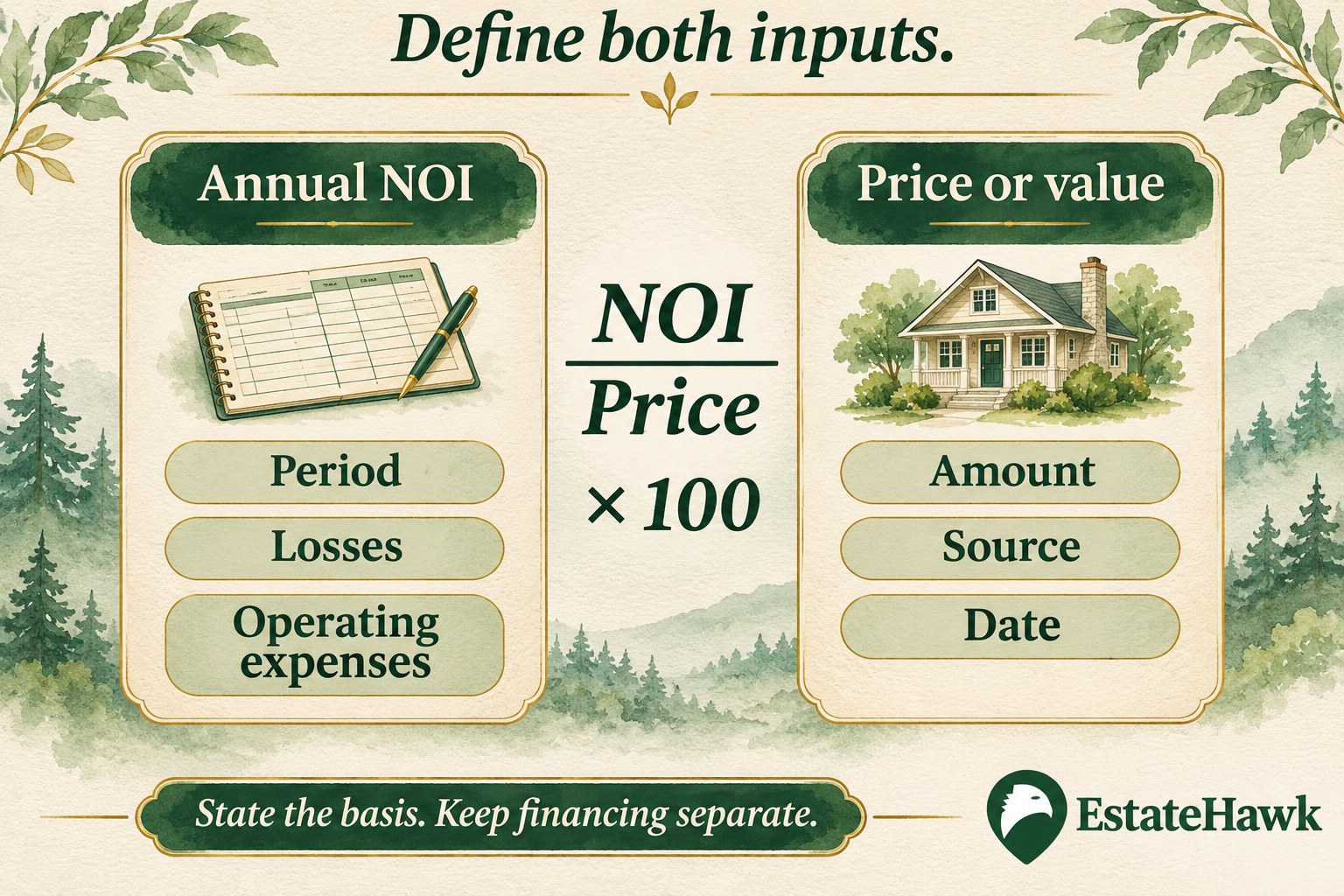
Annual Net Operating Income divided by Stated Property Price or Value, multiplied by one hundred.
Look at the words in that formula.
In the numerator, you have Net Operating Income, universally known as NOI.
In the denominator, you have the total purchase price or asset value.
Notice what is completely absent from that formula:
Mortgage payments do not exist in a cap rate.
Interest rates do not exist in a cap rate.
Down payments do not exist in a cap rate.
A cap rate tells you exactly one factual thing: what percentage annual yield this property would generate if you bought it for one hundred percent cash, with zero debt, before paying income taxes.
That is why institutional investors love cap rates: it allows them to compare an office building in Atlanta with an apartment complex in Phoenix on an equal, unleveraged basis, stripping away the distorting effects of individual buyers' differing loan structures.
However, that elegance is precisely why amateur investors destroy themselves with cap rates.
Because they fail to understand how Net Operating Income is constructed.
Let us conduct a forensic audit of the numerator: Net Operating Income.
To reach a credible, bankable NOI, you must construct a disciplined, multi-step income waterfall:
Step one is Potential Gross Income, or PGI. This is the total gross scheduled rent the property would generate if every single unit were occupied every single day of the year at full market rent.
Step two is subtracting Vacancy and Credit Loss.
Amateur investors routinely accept broker pro formas showing zero percent or two percent vacancy.
In the real commercial world, apartments experience physical turnover, tenant defaults, eviction downtime, and uncollected bad debt. Under institutional underwriting standards, such as Freddie Mac and Fannie Mae multi-family guidelines, an analyst models a realistic submarket vacancy and collection loss, typically five to eight percent of gross revenue, yielding Effective Gross Income, or EGI.
Step three is subtracting Operating Expenses.
This is the exact battlefield where dishonest sellers and aggressive listing brokers inflate cap rates.
Operating expenses include all recurring physical costs required to operate and maintain the real estate:
County ad valorem property taxes.
Building hazard, flood, and general liability insurance.
Professional third-party property management fees.
Routine repairs, maintenance calls, and turnover cleaning.
Landlord-paid common area utilities, water, sewer, and trash.
Landscaping, snow removal, pest control, and elevator service contracts.
Municipal rental inspection permits, business licenses, and accounting fees.
When you subtract realistic operating expenses from Effective Gross Income, you finally reach Net Operating Income.
Now look at what must NEVER be deducted to reach NOI:
First, mortgage debt service. Debt service is a financing expense, not an operating expense. If you subtract mortgage principal and interest payments from your income and divide by price, you are no longer calculating a cap rate; you have created a corrupted hybrid calculation that tells you nothing.
Second, Capital Expenditures, universally known as CapEx.
CapEx includes major structural replacements: replacing a twenty-year roof, repaving a fifty-car asphalt parking lot, or replacing twenty commercial HVAC units.
Under standard appraisal practice, such as California Board of Equalization direct capitalization guidelines, major capital improvements are excluded from baseline operating expenses because they represent long-term capital assets that provide utility over decades. However, a prudent investor must account for these below the line through dedicated capital reserves, because a pristine cap rate does not make a leaking roof disappear.
Third, depreciation and federal income taxes. Depreciation is a non-cash paper accounting deduction, and income taxes are personal to the investor's tax bracket, having zero connection to the physical building's operational efficiency.
Now let us walk through a concrete, real-world mathematical calculation using a fictional residential rental property:
Suppose an investor evaluates a property with a stated purchase price of $300,000.
The property generates $3,000 per month in gross scheduled rent, which equals $36,000 per year.
The analyst models a five percent vacancy and collection allowance, subtracting $1,800, leaving an Effective Gross Income of $34,200.
The verified annual operating expenses, consisting of property taxes, insurance, management, and routine maintenance, total $13,200.
Now calculate Net Operating Income:
$34,200 Effective Gross Income minus $13,200 in operating expenses equals an NOI of $21,000 per year.
Now calculate the baseline Cap Rate:
Take your $21,000 annual NOI. Divide it by the $300,000 purchase price. Multiply by one hundred.
Your baseline Cap Rate is exactly 7.0 percent.
That calculation took ten seconds.
Now let us perform the work that ninety-nine percent of amateur investors fail to execute: stress-testing the assumptions.
A static cap rate is a snapshot of an idealized moment. It assumes that tomorrow will look exactly like yesterday.
In the real commercial world, operational assumptions are fragile.
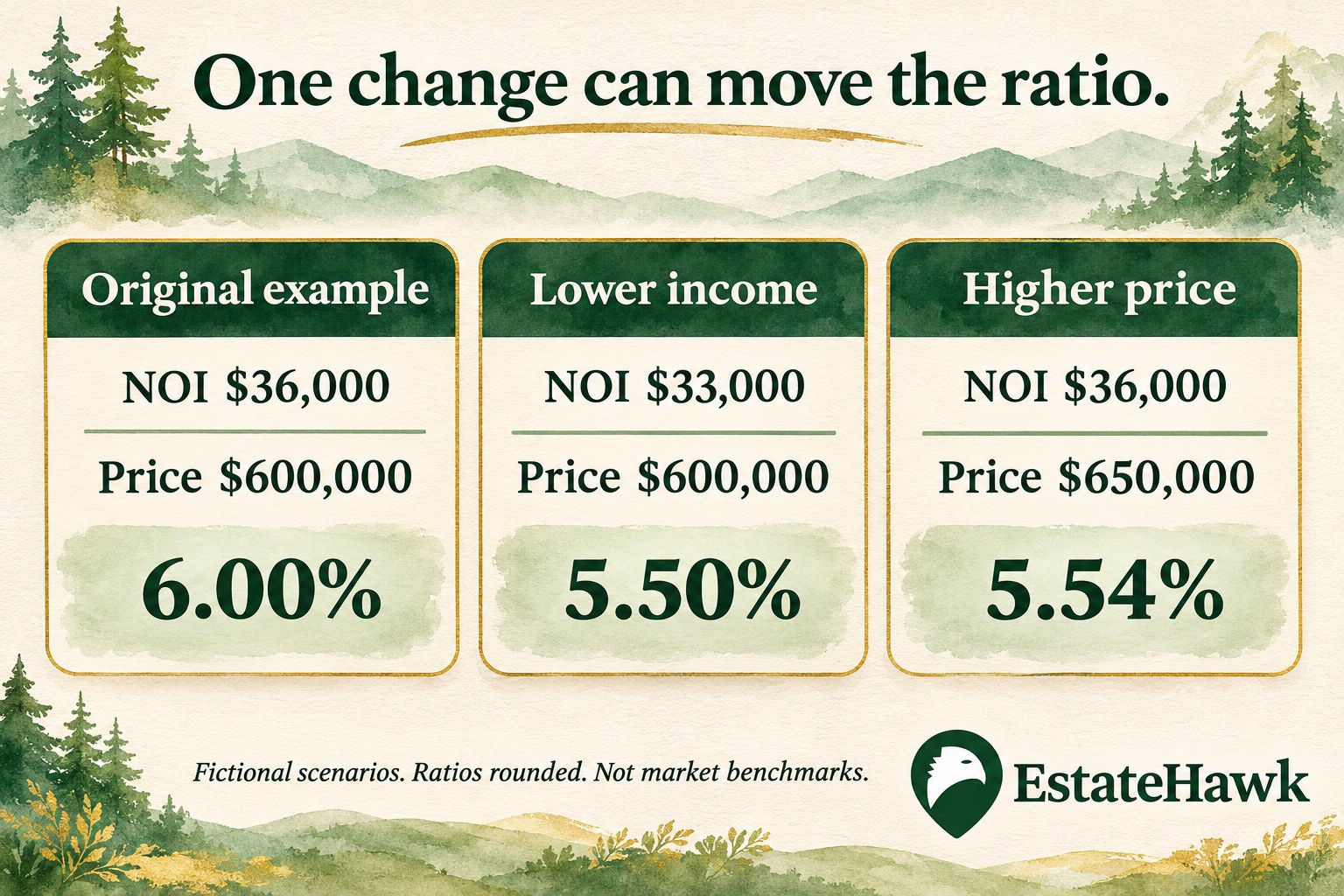
Let us stress-test our 7.0 percent baseline cap rate under three realistic market shifts:
Scenario A: A softening rental market.
Suppose local economic conditions soften, nearby new construction increases supply, and you are forced to lower rents by $300 a month to maintain occupancy.
Your gross revenue drops by $3,600 per year.
Assuming operating expenses remain identical, your Net Operating Income drops from $21,000 to $17,400.
Divide $17,400 by your $300,000 purchase price.
Your Cap Rate collapses from 7.0 percent down to 5.8 percent. A minor ten percent drop in rent destroyed one hundred and twenty basis points of your operational yield.
Scenario B: An operating expense spike.
Suppose market rents stay stable, but your commercial property insurance carrier raises premiums by forty percent, and the local county tax assessor re-evaluates the property, increasing operating expenses by $3,000 per year.
Your operating expenses jump from $13,200 to $16,200.
Your Net Operating Income drops from $21,000 down to $18,000.
Divide $18,000 by your $300,000 purchase price.
Your Cap Rate drops from 7.0 percent down to 6.0 percent.
Scenario C: Overpaying for the asset.
Suppose you get caught in a bidding war and agree to pay $350,000 for the property instead of $300,000, while your NOI remains at the baseline $21,000.
Divide $21,000 by your new purchase price of $350,000.
Your Cap Rate drops from 7.0 percent down to 6.0 percent.
That sensitivity analysis demonstrates why you must never accept a broker's cap rate at face value. You must know exactly how much room your margin leaves when rents soften, taxes jump, or insurance premiums rise.
Now let us dismantle the most dangerous myth in commercial real estate: the belief that a higher cap rate is always better.
Amateur investors look at two properties on an investment sheet:
Property One has an advertised Cap Rate of 5.0 percent.
Property Two has an advertised Cap Rate of 10.0 percent.
The amateur investor immediately screams: "Property Two is twice as good! It generates ten percent instead of five percent!"
That is a catastrophic misunderstanding of real estate finance.
In commercial real estate, a capitalization rate is an inverse measure of risk.
A cap rate is the market's pricing of risk.
Why does Property One trade at a 5.0 percent cap rate?
Because Property One is a class-A apartment building located in a booming coastal submarket with top-tier school districts, high-income corporate tenants, high occupancy, zero deferred maintenance, and immense historical appreciation. Investors eagerly accept a low 5.0 percent yield because the risk of capital loss is near zero, and the underlying land value is expanding rapidly.
Why does Property Two trade at a 10.0 percent cap rate?
Because Property Two is an eighty-year-old brick building located in a declining industrial town with a shrinking population, high crime rates, chronic thirty percent tenant vacancy, constant collection defaults, ancient galvanized plumbing, and zero prospects for future appreciation.
The market demands a 10.0 percent yield on Property Two as a heavy risk premium because the asset carries a massive probability of catastrophic operational failure and capital loss.
Buying real estate by simply searching for the highest cap rate is the financial equivalent of buying junk bonds from a bankrupt corporation because they offer a higher interest rate than United States Treasury bills.
Now consider the vital distinction between Cap Rate and Cash on Cash Return.
Amateur investors routinely confuse these two percentages, using them interchangeably in conversation.
They measure completely different universes.
A Cap Rate measures the unleveraged productivity of the physical building relative to its purchase price, ignoring debt.
Cash on Cash Return measures the cash yield on the actual personal equity cash invested by the buyer, after subtracting mortgage principal and interest debt service payments.
If you purchase a property for cash, your Cap Rate and your Cash on Cash Return are virtually identical.
However, the moment you introduce leverage, taking out a seventy-five percent mortgage loan, your Cash on Cash Return will diverge wildly from your Cap Rate based on your loan terms, interest rates, and down payment.
A property can have an attractive 7.5 percent Cap Rate, but if you finance it with an expensive nine percent interest-rate hard money loan, your debt service will swallow your entire Net Operating Income, leaving you with a negative Cash on Cash Return.
Never use a cap rate to evaluate whether your monthly mortgage payment is safe. You must run a full levered cash flow model.
Let us walk through an educational case study that demonstrates how an unverified cap rate assumption destroyed an investment.
Consider an investor named Brandon who evaluates an eight-unit apartment building on Elmwood Terrace listed for $850,000.
The listing broker delivers a glossy offering memorandum showing the following financial figures:
Gross Scheduled Rent: $96,000 per year ($8,000 per month).
Operating Expenses: $26,000 per year.
Net Operating Income: $70,000 per year.
Advertised Cap Rate: 8.24 percent ($70,000 divided by $850,000).
Brandon is completely dazzled. An 8.24 percent cap rate in today's market looks like a spectacular investment.
Brandon writes an offer, negotiates the price down to $800,000, achieving an apparent 8.75 percent cap rate, waives his financial audit contingency, and closes the purchase.
Then Brandon steps into operational reality.
First, Brandon discovers that the broker's pro forma modeled zero percent vacancy. In reality, two of the eight units are currently vacant, and the local submarket averages an eight percent turnover vacancy. In his first year, Brandon loses $7,680 in vacancy and uncollected rent.
Second, Brandon works full-time and cannot manage eight tenant units himself. He hires a reputable professional property management company charging eight percent of collected revenue, adding $7,065 in annual management fees that never appeared on the broker's pro forma.
Third, and most devastating of all, comes the county tax collector.
The seller had owned the property since 1996, and the property taxes were grandfathered at an artificially low assessed value of $220,000, resulting in an annual tax bill of just $4,400.
Following Brandon's purchase at $800,000, the county tax assessor automatically reassesses the property to its new transfer price.
Brandon's annual property tax bill skyrockets from $4,400 to $16,000 per year, an immediate $11,600 increase in operational overhead.
Look at Brandon's true, audited Net Operating Income at the end of year one:
Actual Effective Gross Income: $88,320.
Actual Operating Expenses: $52,265 (including real taxes, insurance, management, and repairs).
Actual Realized Net Operating Income: $36,055.
Now calculate Brandon's true Cap Rate on his $800,000 purchase price:
Divide $36,055 by $800,000.
The true realized Cap Rate is 4.5 percent.
Brandon thought he was buying an 8.75 percent yield asset. In reality, he bought a 4.5 percent asset.
Brandon took out a $600,000 mortgage at 6.5 percent interest to fund the purchase, requiring $45,500 in annual debt service.
Subtract $45,500 in debt service from his $36,055 actual NOI.
Brandon's cash flow is negative $9,445 per year. Brandon is losing nearly eight hundred dollars a month out of his personal salary to keep the building open.
Brandon lost capital and trapped his credit in an underperforming asset because he accepted an unverified broker pro forma that hid vacancy, management, and a massive tax reassessment.
Now let us examine the four conversational questions that arise whenever property investors evaluate capitalization rates.
The first question involves financing: Does a Capitalization Rate account for mortgage interest rates, down payments, or monthly debt service payments?
No. That is the foundational definition of the metric. A Cap Rate is an unleveraged property-level metric that evaluates the pure operational productivity of the physical real estate, completely independent of how the purchase is financed. Mortgage principal and interest payments must never be deducted when calculating Net Operating Income, and down payment amounts must never be used in the denominator. Cap rate reflects the asset; financing terms must be evaluated separately through a levered cash on cash return model.
The second question concerns risk: Is an investment property with a high Cap Rate always superior to a property with a low Cap Rate?
Never assume that. In commercial real estate, a capitalization rate is an inverse expression of perceived market risk. Properties in high-demand, stable markets with institutional tenants and strong appreciation trade at low cap rates because the risk of capital loss is minimal. Properties trading at high cap rates are almost always located in economically distressed or declining markets, burdened by severe deferred maintenance, high tenant turnover, or collection risk. A high cap rate represents a risk premium demanded by the market, not a guarantee of higher net profits.
The third question involves financial comparisons: What is the specific mathematical difference between a Cap Rate and a Cash on Cash Return?
The difference lies entirely in the denominator and the treatment of debt. A Cap Rate divides Net Operating Income by the total property purchase price or market value, measuring unleveraged asset yield. Cash on Cash Return divides Annual Before-Tax Cash Flow, which is the cash remaining after mortgage debt service has been paid, by the actual out-of-pocket cash equity invested by the buyer. Cap Rate measures the building; Cash on Cash Return measures the performance of your personal leveraged capital.
The fourth question addresses technology: Where do modern property software platforms and automated valuation tools fit into Cap Rate analysis?
Online real estate software platforms and commercial databases are outstanding tools for preliminary deal discovery, tracking regional sales comps, reviewing zoning classifications, and analyzing submarket cap rate benchmarks. However, automated algorithms cannot review signed tenant lease contracts, audit historical utility bills, inspect the physical condition of mechanical equipment, or predict post-sale county property tax reassessments. Software data must always be verified by auditing actual historical operating statements, reviewing certified tax records, and conducting professional on-site physical inspections before executing binding commercial agreements.
When you evaluate a commercial property acquisition, approach the Capitalization Rate with absolute analytical discipline.
Never accept an advertised broker pro forma. Audit the historical operating statements, deduct realistic allowances for vacancy and professional management, calculate the post-closing property tax reassessment, and test how sensitive your yield is to market shifts.
Operating with that level of financial and operational rigor is what protects your capital, preserves your equity, and ensures that your commercial acquisitions represent genuine real estate wealth rather than spreadsheet illusions.