
Abstract of Title: What It Shows and How to Order It
A record history needs a defined scope, a current endpoint and the right professional examination. Learn what to request before ordering or reusing an abstract.
 By EstateHawk
On this page
Let's talk about the act of holding a two-hundred-page leather-bound book from 1924. If you listen to old-school real estate folklore, your first tip when buying an older property in the Midwest is almost always to grab the seller's ancient abstract of title, blow the dust off the cover, and assume you possess a certified guarantee of clear ownership.
Who would have thought?
Take a heavy, ribbon-tied paper dossier assembled by a bespectacled county clerk during the Great Depression, flip through its yellowed typewritten pages showing land grants from President Ulysses S. Grant, and rest easy knowing that your ownership is bulletproof. Truly majestic historical nostalgia. So elegant in its simplicity. So exquisitely disastrous when you discover three months after closing that the abstract's certified endpoint stopped in October 2011, completely missing an active fifty-thousand-dollar state tax warrant, an unreleased mechanics lien from a solar contractor, and an unprobated spousal inheritance interest recorded in 2019.
While we're distributing revolutionary advice, let's make sure high-speed train engineers remember to close their eyes and accelerate through red signals during dense fog. Let's make sure heart surgeons remember to leave their operating instruments inside the patient as charming personal souvenirs.
No, "just take the old abstract from the seller" is advice manufactured for fake title researchers. It belongs to the casual hobbyists who confuse a historical bibliography with a modern legal conclusion. Those people think an abstract of title is an insurance policy that will magically pay their legal fees if an angry long-lost heir emerges from the woodwork demanding fifty percent of the family farm.
Here's what the title company sales brochures and superficial real estate blogs will never explain: for an authentic title examiner, licensed abstractor, or real estate litigation attorney, dissecting an abstract of title isn't a casual history lesson, it's an obsession they have zero control over.
If you let an authentic title obsessive anywhere near an abstract book, their brain completely disconnects from all standard conversational pleasantries. Normal people look at the bound document and admire the antique calligraphy and the embossed gold notary seals. The document obsessive could not care less about the calligraphy. They want to know the exact certified cutoff date and time stamped on the final certificate page, whether the abstract plant that compiled the records holds a valid operating license under the Oklahoma Abstractors Board or regional statutory standards, whether the legal description in entry number forty-seven contains a fatal metes and bounds closure error, and whether an independent examining attorney has issued a formal written Title Opinion under Iowa Title Guaranty protocols or state Marketable Record Title Acts.
In fact, if you leave that researcher unsupervised at two in the morning with an open browser, they won't even be reviewing title continuations at all. They will have fallen headfirst into an algorithmic rabbit hole on a Siberian heavy industrial machinery exchange, studying auction listings for a decommissioned Soviet GT-T heavy amphibious tracked cargo transporter. They will spend two solid hours examining technical blueprints of its 200-horsepower V-8 diesel engine and wide steel track assemblies, analyzing how its watertight steel hull allowed it to transport two tons of seismic exploration gear through freezing muskeg swamps at twenty-five miles an hour, calculating whether its stamped steel road wheels would seize up while crossing an ice-choked river in the Ural Mountains, and reading translated forum flame wars from 2011 about whether synthetic cold-weather grease dissolves the rubber seals in its torsion-bar suspension arms.
Then the Instant Gratification Monkey at the back of their brain gets hit with a cold shock of pure dread. The Rational Decision-Maker kicks down the door, drags them away from Soviet Arctic amphibious transport crawlers, and slams their face back into the abstract continuation certificate. Because right there on entry number one hundred and twelve is an unreleased mortgage from 2004, and the buyer is scheduled to wire three hundred thousand dollars to escrow tomorrow morning.
Welcome to the meticulous, indispensable world of the Abstract of Title.
The foundational trap that catches property buyers completely off guard begins with a total failure to understand what an abstract of title actually is in the eyes of real property law.
An abstract of title is not a title insurance policy.
It is not a government guarantee of ownership.
It is not a legal opinion.
An abstract of title is a compiled, chronological legal bibliography of every single recorded public document, court proceeding, judicial decree, probate matter, tax lien, and encumbrance affecting a specific, legally defined parcel of real estate, starting from the original sovereign land patent issued by the government down to a specific, certified cutoff date.
Notice that phrase: a legal bibliography.
An abstract of title contains the raw historical evidence. It shows that in 1888, John Doe granted an easement to the railroad. It shows that in 1922, Mary Smith took out a mortgage for twelve hundred dollars. It shows that in 1964, a probate court entered a final decree of distribution dividing the farm among four siblings.
However, the abstract itself does not tell you whether that 1888 railroad easement is still valid. It does not tell you whether that 1922 mortgage was properly released according to state statutes. And it does not tell you whether those four siblings in 1964 had legal capacity to convey the soil.
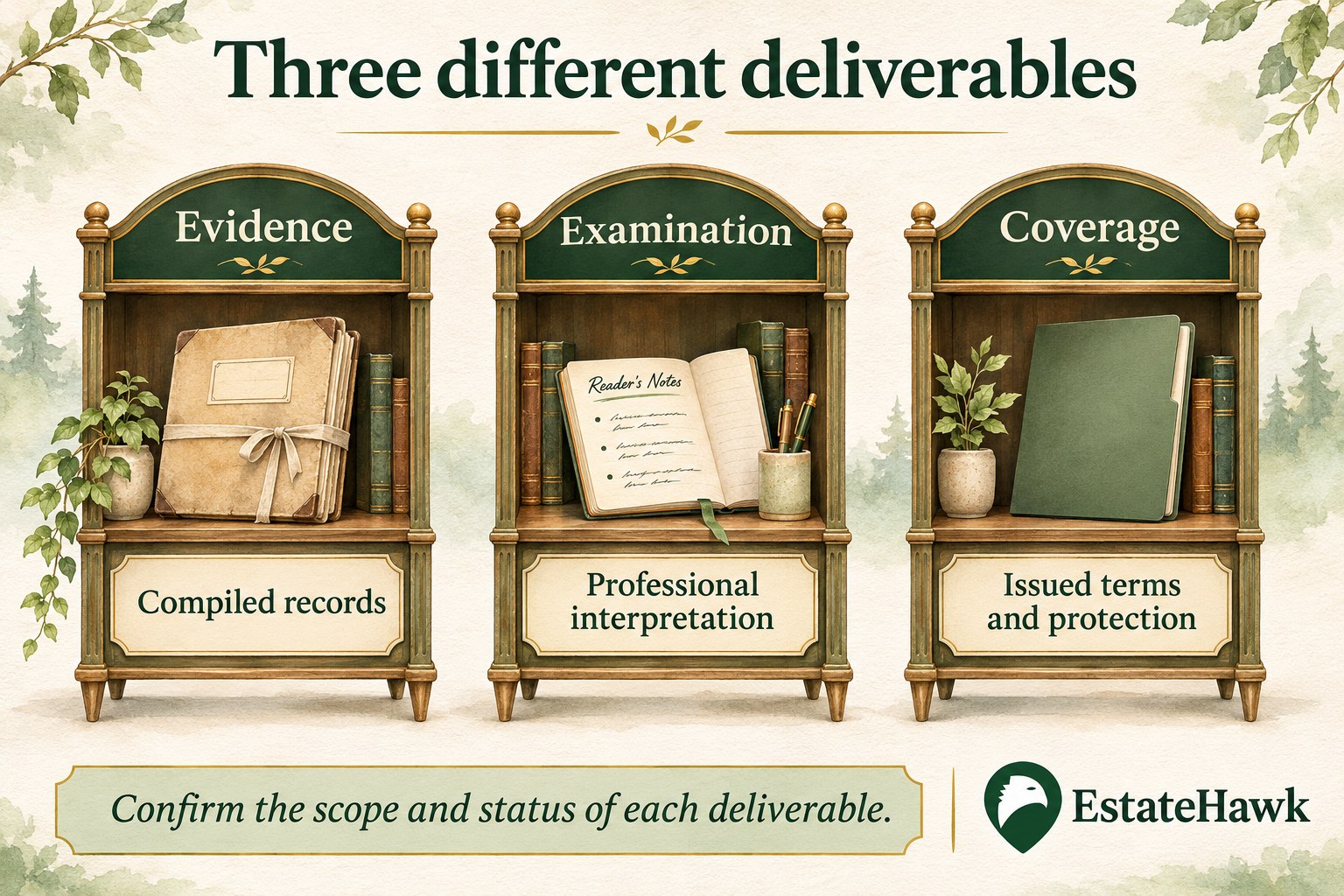
To turn that historical evidence into legal safety, you must strictly separate three distinct operational pillars:
Pillar number one is the Abstract of Title. This is the compiled documentary evidence assembled by a licensed, bonded abstractor using an independent, geographically indexed abstract plant.
In states like Oklahoma, the Oklahoma Abstractors Board strictly regulates and licenses abstracting companies. An abstractor does not simply search an online county recorder index by name. They maintain a physical or digital abstract plant, an independent private index that tracks every square inch of land in the county by section, township, and range, or by subdivision lot and block, ensuring that misindexed deeds or misspelled grantor names never escape detection.
Pillar number two is the Title Opinion.
This is the legal examination. An abstract of title is completely useless to a property buyer until it is placed in the hands of an experienced real estate examining attorney.
The examining attorney reads every single entry in the abstract, examines the legal descriptions, verifies that every mortgage has a recorded release, checks that every probate proceeding followed statutory notice requirements, and evaluates whether any cloud on title exists.
The attorney then issues a formal, written legal document called an Attorney's Title Opinion. The title opinion states who lawfully owns the real estate, lists every active lien and encumbrance that must be cleared prior to closing, and specifies the exact legal requirements necessary to make title marketable under state law.
In Iowa, this two-step system is the foundation of the entire state's real property market. Iowa is the only state in the United States that completely outlawed commercial title insurance companies by statute.
Instead, under the Iowa Title Guaranty system, participating licensed abstractors compile the abstract of title, participating real estate attorneys examine the abstract and render formal title opinions, and the state government issues an Iowa Title Guaranty Certificate that protects lenders and buyers against covered title losses.
Pillar number three is Title Insurance.
In the remaining forty-nine states, commercial title insurance companies dominate the market. As the Texas Title Insurance Manual and standard American Land Title Association guidelines illustrate, a title commitment and title policy are indemnity contracts. The title company reviews public records, issues a commitment agreeing to insure the buyer's ownership, and agrees to indemnify the owner for covered title defects that arose prior to the policy date, subject to Schedule B exceptions.
Now consider the most lethal procedural trap in abstract examination: the endpoint and the gap risk.
An abstract of title is a snapshot in time. It is only as good as the exact date and minute stamped on its final certification page.
Look at how amateur investors destroy themselves with older abstracts:
A buyer is purchasing an inherited home from an estate in an abstract state.
The seller pulls a heavy, bound abstract out of a metal safe deposit box. The seller proudly points to the final page, which bears the embossed seal of a licensed county abstract company.
The buyer looks at the seal, sees the word "Certified," and thinks: "The abstract is certified! Title is clean!"
The buyer fails to read the date above the seal.
The certification was signed on June 14, 2012.
That abstract is twelve years old. It tells you what happened to the property between 1870 and June 14, 2012.
It tells you absolutely zero about what happened between June 15, 2012, and today.
During those twelve intervening years, the previous owner might have taken out a home equity loan for seventy-five thousand dollars. A roofing contractor might have recorded a mechanics lien for eighteen thousand dollars. The IRS might have recorded a federal tax lien. Or the owner might have granted an expansive utility easement across the back lawn.
None of those encumbrances will appear in the 2012 abstract.
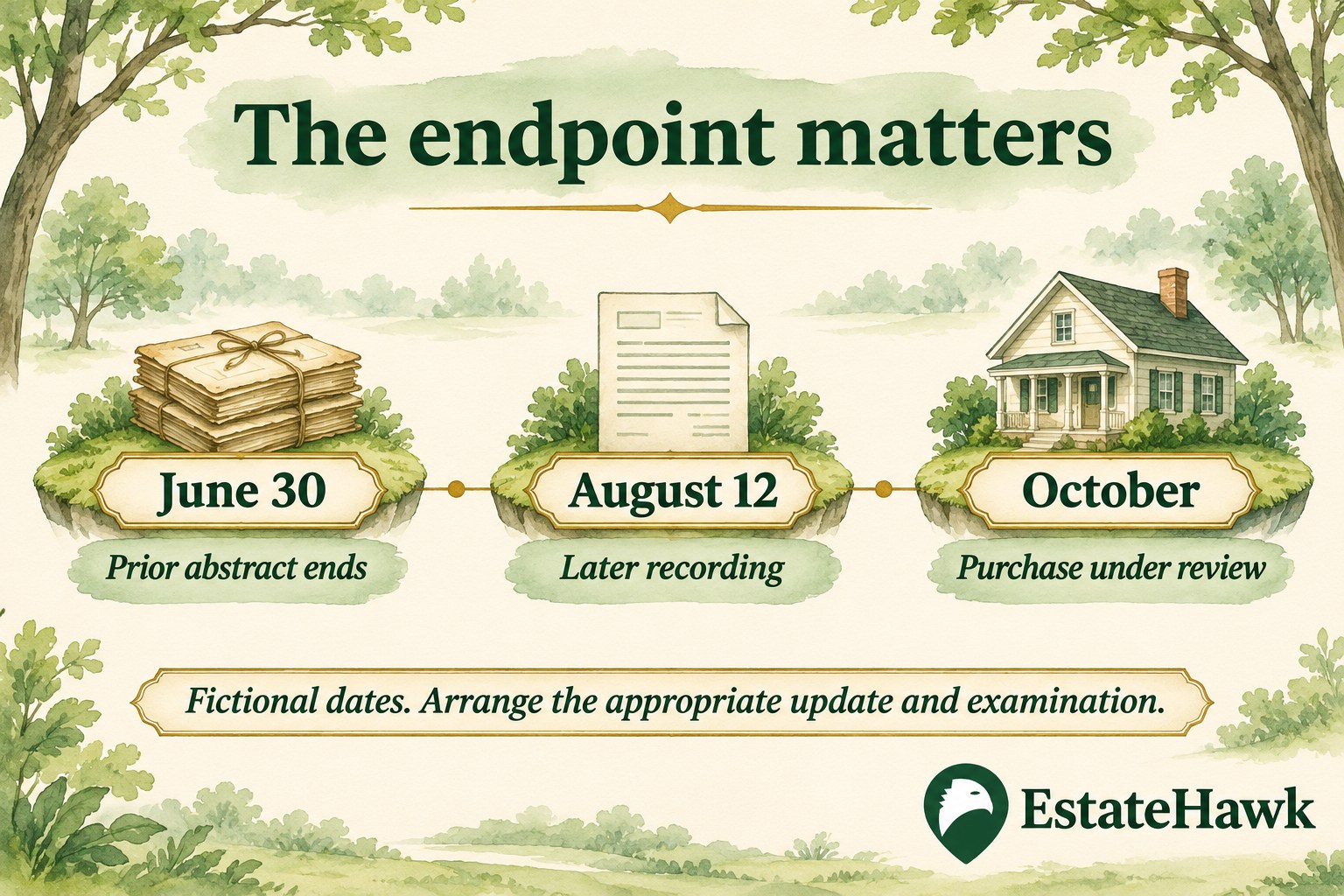
To make an existing abstract usable for a modern real estate transaction, you must order an Abstract Continuation, commonly referred to in the industry as an abstract update, stub search, or gap search.
You deliver the existing bound abstract to a licensed abstract company in the county where the property is located.
The abstractor searches the county records starting from the exact minute the previous certificate ended, June 14, 2012, at 5:00 PM, and pulls every recorded document up to the present calendar date.
The abstractor binds those new pages onto the back of the original abstract and signs a new, updated certification certificate.
Only then can the examining attorney review the full, unbroken chain of title down to the date of your purchase.
Now consider Marketable Record Title Acts and the concept of the root of title.
In many states across the Midwest and South, such as Ohio under the Ohio Marketable Title Act (ORC 5301.47) and Florida under the Marketable Record Title Act (Chapter 712), state legislatures enacted statutes to simplify title examination.
These statutes declare that if a landowner possesses an unbroken chain of record title stretching back for a statutory period, typically forty years in Ohio or thirty years in Florida, starting from a foundational conveyance known as the root of title, all conflicting property claims, ancient easements, and unrecorded interests created prior to that root of title are legally extinguished by operation of law.
Understanding whether your state operates under a marketable title statute dictates how far back an abstract continuation must go, and prevents examiners from getting bogged down in 19th-century probate disputes that were legally extinguished decades ago.
Now let us examine physical preservation, replacement costs, and lost abstracts.
This is a practical reality that shocks real estate investors who are accustomed to modern digital cloud storage.
In abstract states like Iowa, Oklahoma, Minnesota, and South Dakota, an original abstract of title is a valuable physical asset.
It is not a disposable paper printout.
An original abstract for an older residential parcel or commercial tract can easily comprise three hundred to five hundred pages of meticulous legal typing, certified maps, and historical seals.
If an owner loses the original abstract, damages it in a house fire, or allows it to be ruined by basement water leaks, you cannot simply click "print" on a website.
To replace a lost abstract, you must hire a licensed abstract company to construct a completely new abstract from scratch, starting from the original sovereign government patent.
Constructing a brand-new original abstract from scratch is an extraordinarily labor-intensive process that can take four to eight weeks and routinely costs between fifteen hundred and three thousand dollars in direct abstractor fees.
Furthermore, if you are selling a property in an abstract state, standard state real estate purchase contracts legally obligate the seller to deliver the complete, certified abstract of title to the buyer for examination. If you cannot produce the abstract, you will be forced to pay thousands of dollars out of your closing proceeds to reconstruct it.
Treat an abstract of title like gold. Store it in a fireproof safe, never tear out pages, never remove notary certificates, and never write personal margin notes on its entries.
Let us walk through an educational case study that demonstrates how an unverified abstract endpoint destroyed an investment.
Consider an investor named Caleb who enters into an agreement to purchase an older three-bedroom home on Prairie Ridge Road in an agricultural county. The seller is an elderly gentleman who is moving to an assisted-living facility.
The seller hands Caleb a thick, pristine, leather-bound abstract of title. The seller tells Caleb: "Here is the abstract. My family has owned this land for sixty years. There are no mortgages on the house. You can take this to the bank."
Caleb looks at the impressive leather binding and the embossed gold lettering on the cover. Caleb is thrilled.
Caleb is trying to save money on transaction costs. Caleb decides not to hire a real estate attorney to examine the abstract, and he decides not to pay the local abstract company four hundred dollars to order an abstract continuation.
Caleb tells himself: "The seller is a reputable church-going man, the abstract is right here in my hands, and the last entry shows his parents' probate in 2008. Title is clear."
Caleb drafts an all-cash warranty deed, the seller signs it before a local notary, Caleb hands the seller a cashier's check for $180,000, and Caleb records the deed at the county courthouse.
Caleb spends thirty thousand dollars remodeling the interior, replacing the kitchen cabinets, and refinishing the hardwood floors.
Six months later, an official deputy sheriff knocks on Caleb's front door.
The deputy serves Caleb with a formal Writ of Execution and a Notice of Sheriff's Sale.
Caleb is completely bewildered. "I own this house free and clear! What is this about?" Caleb demands.
Caleb rushes to a seasoned real estate litigation attorney.
The attorney inspects the leather-bound abstract and checks the county court dockets.
The attorney delivers the devastating truth.
The abstract Caleb held in his hands was certified through November 14, 2008. That was sixteen years ago.
In 2017, the seller had co-signed a major commercial business loan for his son's trucking company. The trucking company went bankrupt. The regional bank sued the seller in county court, won a formal money judgment for $68,000, and recorded a certified judgment transcript in the county clerk's judgment docket under Instrument Number 2017-08412.
Under state law, that recorded judgment attached as an automatic judgment lien against all real estate owned by the seller in that county.
Because Caleb never ordered an abstract continuation, Caleb had zero knowledge of the 2017 judgment lien.
And because Caleb bought the house without title insurance and without clearing the judgment, Caleb purchased the property subject to the bank's judgment lien.
The judgment lien remained fully enforceable against the real estate. With statutory post-judgment interest of ten percent accruing over seven years, the judgment balance had ballooned to ninety-four thousand dollars.
The bank was executing a sheriff sale to seize and auction the house to satisfy the debt.
To keep the sheriff from selling his newly renovated home on the courthouse steps, Caleb was legally forced to pay the bank ninety-four thousand dollars in cash out of his personal savings, on top of the $180,000 he had already paid the seller and the $30,000 he had spent on renovations.
Caleb lost ninety-four thousand dollars because he relied on a sixteen-year-old abstract endpoint and tried to save four hundred dollars on an abstract continuation.
Now let us examine the four conversational questions that constantly arise whenever property buyers encounter an abstract of title.
The first question involves legal products: Is an abstract of title the exact same thing as a policy of title insurance?
No. They are fundamentally distinct products. An abstract of title is a compiled historical summary of public records affecting the property, assembled by an abstractor. It contains evidence, but provides zero financial indemnification and zero guarantee of title marketability. A title insurance policy is a legally binding contract of indemnity issued by a professional underwriting corporation. If a title defect arises, an abstractor is only liable for clerical negligence in failing to include a recorded instrument, whereas a title insurance company is contractually obligated to pay your legal defense costs and compensate you for covered financial losses up to the full policy amount.
The second question concerns document age: Can a property buyer safely rely on an older abstract of title provided by the seller without paying for an update?
Never. An abstract of title is strictly limited to the precise cutoff date and minute stamped on its final certificate page. If an abstract was certified ten years ago, two years ago, or even three months ago, it provides zero information regarding what has happened to the title between that certification date and today. Tax liens, judgments, second deeds of trust, mechanics liens, and divorce decrees recorded after the cutoff date will not appear in the older document. You must always deliver the abstract to a licensed abstract company to order a formal continuation bringing the certification forward to the exact date of your purchase.
The third question involves lost records: What happens if an original physical abstract of title is lost, damaged, or destroyed?
Losing an original abstract of title is a serious financial problem in abstract states. Because an abstract represents decades or centuries of compiled land records, reconstructing a lost abstract from scratch requires hiring a licensed abstract company to research the property from the original government sovereign patent down to the present day. This process can take four to eight weeks and routinely costs between fifteen hundred and three thousand dollars in out-of-pocket abstractor fees. Many standard purchase contracts require the seller to deliver the original abstract at closing, meaning a lost abstract will delay closing and reduce the seller's net proceeds.
The fourth question addresses technology: Where do modern property software platforms and digital county portals fit into title abstracting?
Digital property intelligence software platforms and online county recorder portals are exceptional tools for preliminary research, checking parcel boundaries, tracking recent recorded deeds, and identifying obvious encumbrances. However, online portals cannot replace a certified abstract of title or a licensed attorney's title opinion. Most county online databases only index documents going back to the 1980s or 1990s, completely omitting ancient easements, mineral reservations, and historical restrictive covenants that remain legally enforceable. Professional title abstracting requires licensed abstract plants, physical deed books, and expert legal examination before executing binding transactions.
When you purchase real estate in an abstract jurisdiction, approach the documentation with absolute discipline.
Never assume an antique book represents clear title. Verify the certified endpoint date on the final page, order a formal abstract continuation from a licensed abstract company to close the gap, and have the complete file examined by an experienced real estate attorney who will issue a written Title Opinion.
Operating with that level of legal and historical rigor is what protects your capital, preserves your equity, and ensures that your real estate ownership is truly marketable, defensible, and secure.